
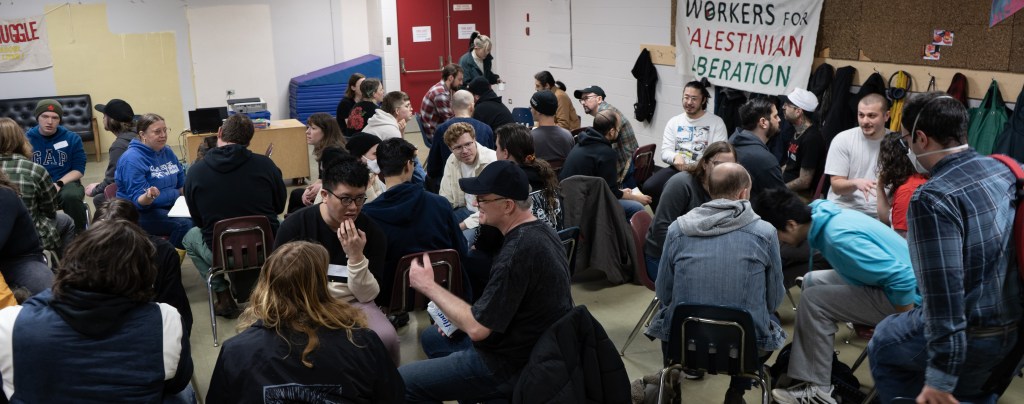
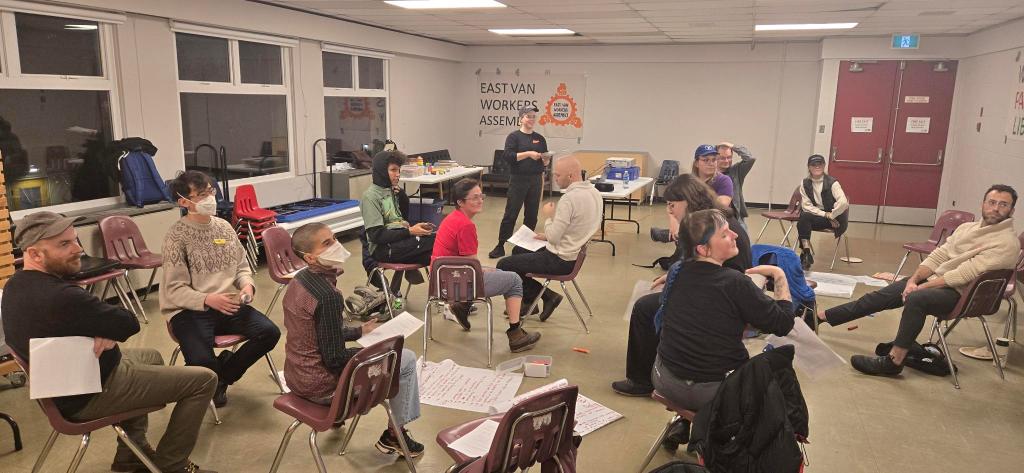
In the February East Van Workers Assembly, we discussed the first proposed Workers Platform Point #1: Establish people’s democratic ownership of the means of production.
We asked on our survey, How could the economy better serve the needs of the working class? Here are just a small sample of the answers we received:
- By being owned and operated by the workers
- If it would be controlled by them.
- Abolishing commodity so that production is socialized, and our needs are then finally met.
- Social control, rational economic planning for human need, economic development to serve the interests of working-class people.
- Power over economic decisions can be further decentralized, beyond city level (through democratic means- real democracy).
- Cap on millionaires, proper taxation for millionaires, don’t let lobbyists for VPD, Zionist groups, Oil and gas lobby make decisions about our “economy”.
- If the workers seize the means they seize the economy, the economy won’t serve the workers otherwise.
- Prevent corporations and capitalists from having so much influence over the government. Prevent profits from being taken out of the economy by the rich and instead redistributed back to workers or reinvested into public services. Loosen restrictions on unions so more workplaces can be unionized and more workers can exert control over their industries.
- The economy needs to be ran by the working class. It is only us who can design and implement an economy which is in our interests.
- Tear down capitalism. Move to a socialist model where the well being of all people is priority.
- Nationalization of industry, command economy
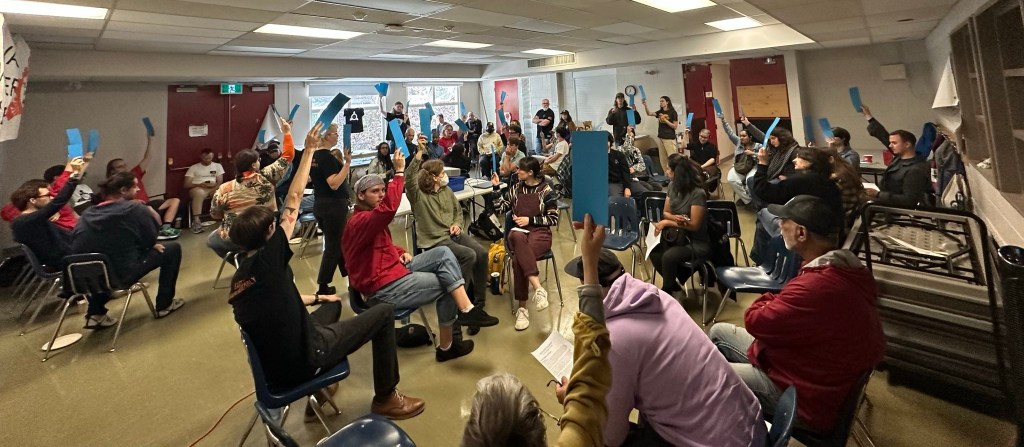
So, at the Assembly, we considered and debated the first point in the Workers Platform on the core concept of people’s democratic ownership of the means of production. We heard a presentation on people’s democratic ownership in history, followed by questions, large group discussion, and small group discussions which were quite lively with debate. Read below for Billy’s speaking notes. Join us at the March Assembly for a synthesis of the discussions and to dig further into worker control of the economy.
What are the means of production?
“In economics, the means of production refers to the generally necessary assets and resources that enable a society to engage in production.” (Wikipedia)
The tools (instruments) and the raw material (subject) you use to create something are the means of production. (Marxists.org)
In our developed capitalist society MoP will include the factories, the farms, the warehouses, the trucks and the tools, the shops and construction equipment.
What is the current system of ownership?
Here we have a super basic class analysis of Canadian society under the system of capitalism. Capitalist system of private ownership – the capitalists own the MoP and that leads them to have complete control of the production process and the ability to extract surplus from the process.
At the top of the pyramid we have the monopoly capitalists, the mega rich owners, people like Pattison and Weston, owners of huge corporations with international reach and a monopoly or oligopoly over the market. Under that we have the middle bourgeoisie – these are the people who own companies but smaller ones without the monopoly control and spread.
Under that are the petty bourgeoisie, these are the people with some professional skills or degrees, like doctors, lawyers, etc. They have some small access to means of production whether through their skills or owning a small business.
And finally the majority of the population, the working class, who go to work every day and sell their labour power to survive, the people who are ultimately responsible for the creation of profit, but see none of the benefits except the small gains that can be fought for under the capitalist system.
Our only ways to limit the influence of the capitalists under the current system are through limited state policy, and organised working class political action. However both of these forms only put bandaids on the problem, which can later be torn off by the capitalists. We need a fundamentally different system of ownership.
What does democracy look like in the economic sphere?
The mobilisation of the masses of working people to take an active role in planning and innovating economic life. It means popular ownership to facilitate collective and democratic decisions over economic affairs, and putting an end to the control of the capitalists who run the economy to create profit for themselves.
An argument that I want to make is that true economic democracy requires popular ownership, eliminating private capital and profit. Without popular and democratic ownership, the domination of the capitalist class over the economic and social lives of working class people will continue. And it can sound kinda abstract or academic when I say it like that, but it reflects a feeling of lack of control, of powerlessness that is common to working class people.
What is democratic and popular ownership of the means of production?
To answer this question we can learn from history, particularly the history of different projects of socialist construction across the world. For the purposes of this presentation and because they are the case studies I’m most familiar with, I will focus on the People’s Republic of China in the period of socialist construction between 1949 and 1978, and the Soviet Union between 1917 and 1956. From these examples we see two primary forms of popular ownership: state ownership, and cooperative or communal ownership. These existed simultaneously in both countries, sometimes with some tension which I don’t have time to get into in this presentation but is an interesting point of investigation in the future.
Forms of popular and democratic ownership:
- State ownership
- Control through the government of collectively held enterprises, owned by the whole of the working class.
- Phasing out of commodity production and labour power as a commodity
- Production is geared towards human need and rational economic development.
- Social surplus is controlled and allocated by the society as a whole in the interests of the society as a whole.
- Cooperative ownership
- Ownership of the means of production and of surplus is held by the workers who contribute to the enterprise.
- Surplus is retained and allocated according to the decisions of the workers.
Examples of popular and democratic ownership:
- Soviet Union
- 1936 Constitution of the Soviet Union:
- Article 5 “Socialist property in the U.S.S.R. exists either in the form of state property (the possession of the whole people), or in the form of cooperative and collective-farm property (property of a collective farm or property of a cooperative association).”
- Article 11 “The economic life of the U.S.S.R. is determined and directed by the state national economic plan with the aim of increasing the public wealth, of steadily improving the material conditions of the working people and raising their cultural level, of consolidating the independence of the U.S.S.R. and strengthening its defensive capacity.”
- People’s Republic of China
- Commune system
- The commune system was used particularly in the agricultural sector and involved the collective ownership of the means of production (including land) of a given area by the inhabitants
- From elementary cooperatives and mutual aid teams to advanced cooperatives and communes
- State ownership of the means of production, and slow policy measures increasing worker control and decreasing commodity production (production for the purpose of sale for profit – this was done by the state playing an intermediary role, buying goods from the state owned enterprises and selling them to the masses)
- State ownership was a form of democratic / popular ownership, and was a necessary step in socialist construction (Pao-Yu Ching, 2019)
- Commune system
Commodity = anything that is produced in order to be sold for a profit on the market
What is the relationship between democratic ownership and control?
Worker agency and control in the economy is based on ownership. In the current system of private ownership workers can only exert some limited power over economic life through collective action.
Contract negotiations, strikes, and public pressure campaigns are some ways we can exert some small control over the economy under capitalism. These small examples are important as they train us to build and use our collective power as workers, but they don’t fundamentally change the system of production which screws us over.
But because of the fundamental system of capitalist ownership over the productive capacity of society any gains made are small and can be rolled back. Fundamental change to the system of ownership is the only thing that can create worker control over the economy.
Conclusion
On state ownership: “Thus, we do not regard the legal transfer of the means of production to the State as the point of departure on the embankment of socialism. Judicial change in ownership is only a point of reference; it is merely an index that marks the historical development until that time. Judicial change in ownership provides the possibility for future changes. Whether the transition is socialist or capitalist depends on the concrete events after the legal transfers.” (Deng-Yuan Hsu & Pao-yu Ching, 1997, p.19)
Neither state ownership or cooperative ownership by themselves constitute the end of capitalism, or the capitalist relations of production – in fact both of them exist under capitalism. However, these forms of ownership offer the potential when combined with other policies and the mobilisation of workers to take an active role in controlling, planning, and executing in the sphere of the economy, to move beyond the current system of private ownership, commodity production, and private extraction of our surplus social wealth.
Working class ownership of the means of production is a necessary precursor to building up a new socialist society where workers have direct control of the economy, where production is geared towards addressing human need and not the endless accumulation of capital, and economic growth and development are rationally and socially determined to promote environmental sustainability and human flourishing.
References:
- “Constitution (Fundamental law) of the Union of Soviet Socialist Republics” Joseph Stalin
- “From Victory to Defeat: China’s Socialist Road and Capitalist Reversal” Pao-Yu Ching
- “Rethinking Socialism: What is Socialist Transition?” Deng-Yuan Hsu & Pao-Yu Ching
 United in Struggle
Leave a comment