
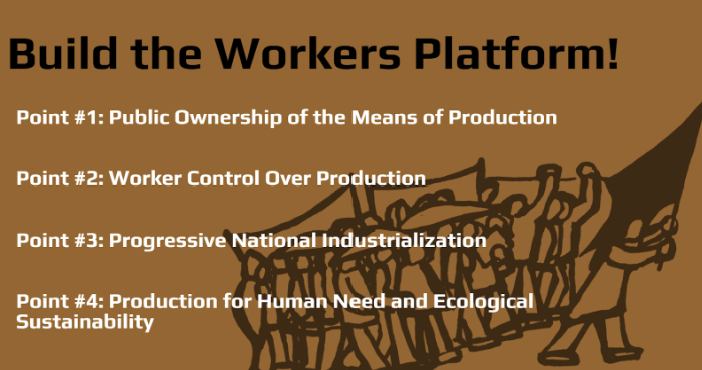
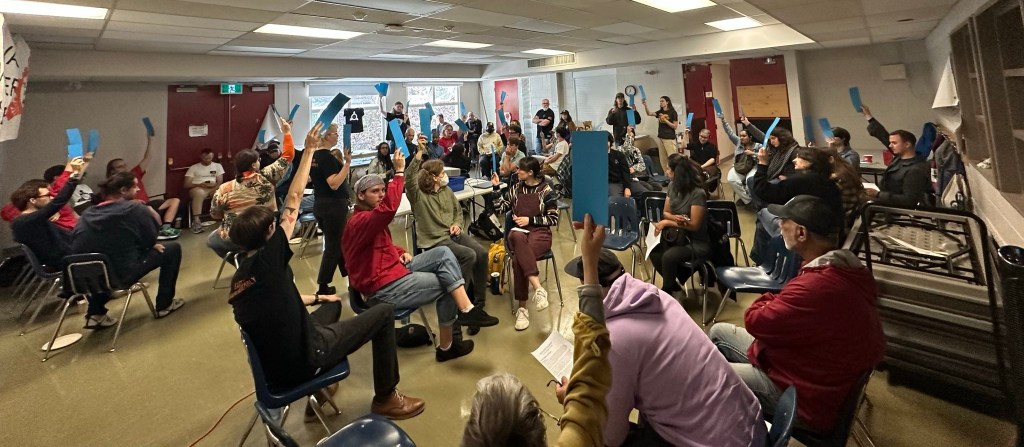
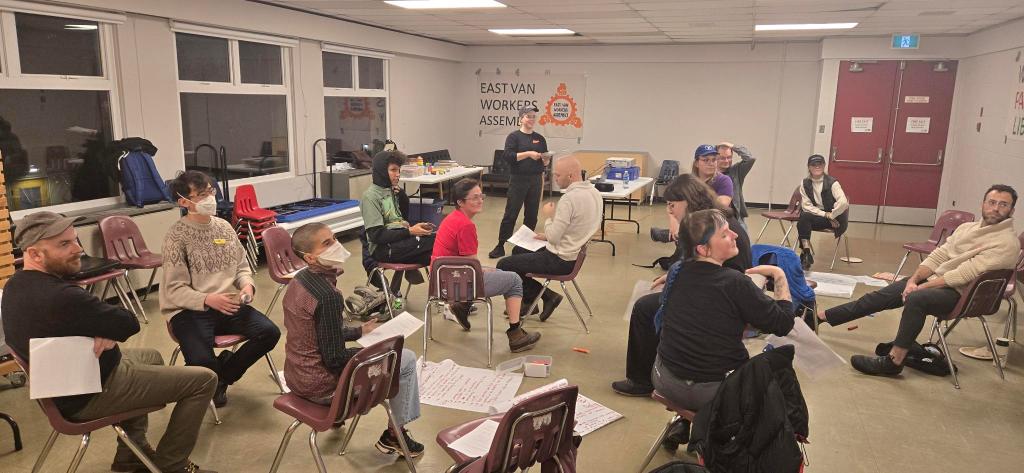
The following are speaking notes from a presentation given by Billy and Carl at the April EVWA on platform points 3+4!
In January the East Van Workers Assembly launched a campaign for 2024 to build the workers platform.
The campaign had a few main objectives: one of them was to use it as a chance to build a base for the assembly. Another objective was to build a platform that we unite on and can use as an orientation to launch campaigns in the future: the platform isn’t the end, it’s just the beginning of building and strengthening the workers movement in Canada into a movement which can fight back against the bosses and the government.
We’re hoping this assembly to round out our broad discussions and positions on the economy, and we’re hoping to take up the question of how we’re approaching and engaging with unions in earnest at the next assembly (on May 26th!). The points we’ve discussed so far in our campaign to build the platform have been:
- Public Ownership of the Means of Production
- Worker Control Over Production
The discussions on these two points have really helped to build our unity around the root causes of our issues as workers. The working class as a whole has little to no control over our economy. Power and control in the economy is based on ownership. In the current system of private ownership workers can only exert some limited power over economic life through collective action. We can see public ownership and worker control as potential solutions to this.
Today we’re going to talk about Progressive National Industrialization, and a little on Production to Serve Human Need and Ecological Sustainability.
- Progressive National Industrialization
- Production to Serve Human Need and Ecological Sustainability

Our economy is parasitical, we export capital and raw resources, and import the things we need for our society for things to function. Progressive National Industrialization is the solution.
Progressive: towards ecological sustainability and human need.
National: people not subject to the whim of the world market, self-sufficient.
Industrialization: ending our parasitic relationship with the third-world. Unleash, rebuild, and repatriate industry.
What is Canada’s place in the global economy?
This section is focused on BC’s and Canada’s place in an imperialist global economy, centering what our economy actually does.
The Canadian economy is geared to resource extraction and export, finance, and service sectors. Canada’s economy is highly dependent on international trade with exports and imports of goods and services each comprising about one-third of GDP. Its three largest industries, measured by their contributions to GDP, are real estate, rental, and leasing; manufacturing; and mining, quarrying, and oil and gas extraction.
Labour intensive manufacture has been moved overseas and capital intensive manufacture has been kept here (so the number of people occupying these jobs and in these sectors is relatively low). Free trade agreements and globalisation have furthered Canada’s focus on extraction and export.

(Government of Canada, 2022)

(CMNE = Canadian Multinational Companies. Government of Canada, 2024)
The Canadian economy is geared towards extracting profit and this means moving manufacturing to places with higher rates of exploitation. Good paying manufacturing jobs have been outsourced to countries where wages are lower, conditions are drastically worse, and subsequently the rate of exploitation (profit) is significantly higher.
The Organization for Economic Development and Cooperation (OECD) predicts that Canada will be the worst performing advanced economy over the next decade. While the Canadian economy is focused on resource extraction and profit, wages have been virtually stagnant for 50 years, while the top 20 percent of households hold almost 70 per cent of all the net worth in the country. Which brings up the question: Who is this economy working for? It serves the big bosses, the monopoly capitalists to further the development of profit and exploitation of workers.
An example of the Canadian economy extracting as much profit as possible at the price of exploitation of workers and devastating environmental degradation is Canadian mining. Approximately 75% of the world’s mining companies are Canadian. There are almost 1,300 mining companies based out of Canada that are investing hundreds of billions of dollars in over 100 countries around the world. Why is this such a lucrative business? When Canadian businesses set up mining operations overseas – it is harder for them to be held accountable for the human rights violations and environmental destruction done overseas. This means less oversight and increased profits. Two recent struggles in Latin America where workers fought back against Canadian mining corporations illustrate the violence and stakes of our imperialist economy.
After years of legal battles, seven Guatemalan farmers successfully sued Tahoe Resources in Canadian courts. This Vancouver-based company was responsible for ordering security to shoot at protesters outside their Escobal Mine operation. Many of the protesters were seriously injured.
In Panama, there was huge opposition to Canadian mining company First Quantum Minerals Ltd.’s Cobre Panama Mine where protesters claimed the contract was steeped in corruption and raised alarms about the impact of the open pit mine on the environment. The new 20 year contract was denounced by environmentalists, Indigenous groups, labour activists and religious groups. Panama’s government ordered the shutdown in December 2023 after protests erupted across the country and a court ruling deemed the contract to run the mine unconstitutional.
These examples serve to illustrate the character of our economy. The Canadian economy exports raw materials and capital overseas, and imports the commodities that our country relies on. It is geared to maximising the profit of big business and not at actually addressing human need and environmental sustainability.
Why is progressive national industrialization the solution?
The main goal of this point is to move production back to Canada. But of course, that can look like many things, so I’ll be going over those points. Ultimately, the end goal for a project of progressive national industrialization is to create a society where we can produce based on human need and ecological sustainability, not private profits and capitalist accumulation.
One of the most important goals of progressive national industrialization is making Canada self-sufficient. By moving production back to Canada and producing as much of the stuff as we need at home as possible, we can ensure jobs for all who want them.
This also lets us end Canada’s imperialist relation to most of the world. By producing more of our needs at home, we no longer need to exploit third-world countries for sweatshop labour and cheap production.
But one of the most important reasons for doing this is to sever our dependence on the capitalist world market. All the workers’ control in the world will be constrained if everything we need to live is produced abroad, forcing us into competition with exploitative capitalists. We’ve all felt the demands of the world market: such as inflation, housing being a finance slush fund, shortages during COVID, etc. By building up Canada’s self-sufficiency, we create the real basis for workers control and all the other points on the workers platform.
Workers could then choose to produce based on their needs and the needs of their community instead of just for the profits of the rich.
Progressive national industrialization is also our best chance of beating climate change. Retooling all of our industry and transitioning our entire economy towards ecological sustainability will be a massive industrial undertaking, one that we can’t trust the capitalist system to fulfil on its own. This means all sorts of things, from replacing all of our fossil-fuel-dependent machinery and electricity production, to reducing supply lines by distributing production across the country and ensuring redundancies.
If we were producing for human need and ecological sustainability rather than capitalist profits, we could also eliminate deliberately wasteful practices like planned obsolescence and wasteful packaging.
Aside from the mechanical side of things, we could also rebuild our communities to encourage more sustainable forms of living, such as building cities that make walking and public transit the most efficient means of moving around. We could distribute workplaces in order to reduce commuting time, encourage local agriculture, and all sorts of other methods.
We could not only use more sustainable technology, but we could also live more sustainable lives.
As part of self-sufficiency and ecological transition, we would want to ensure equal development across all of Canada. Progressive national industrialization could involve building infrastructure linking remote communities, bringing back thriving economic activity to towns decimated by deindustrialization. Putting sustainable economic development on the agenda in rural Indigenous communities will be an essential component in their struggles for self-determination and national liberation.

This would of course also entail making sure that rural communities have their needs met, such as building hospitals and schools in areas in desperate need or providing clean drinking water to Indigenous communities long-neglected by the Canadian government.
By distributing production more equitably across the country we also make ourselves more resilient to natural disasters or other calamities.


 United in Struggle
Leave a comment