

Democratizing the Workers Movement
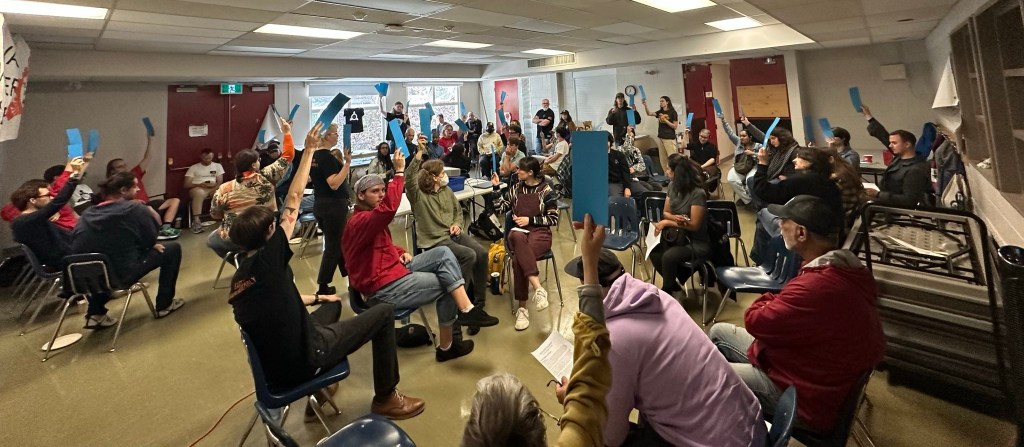
The last three assemblies we’ve spent uniting on our basic vision for the economy through our 2024 campaign to build the workers platform.
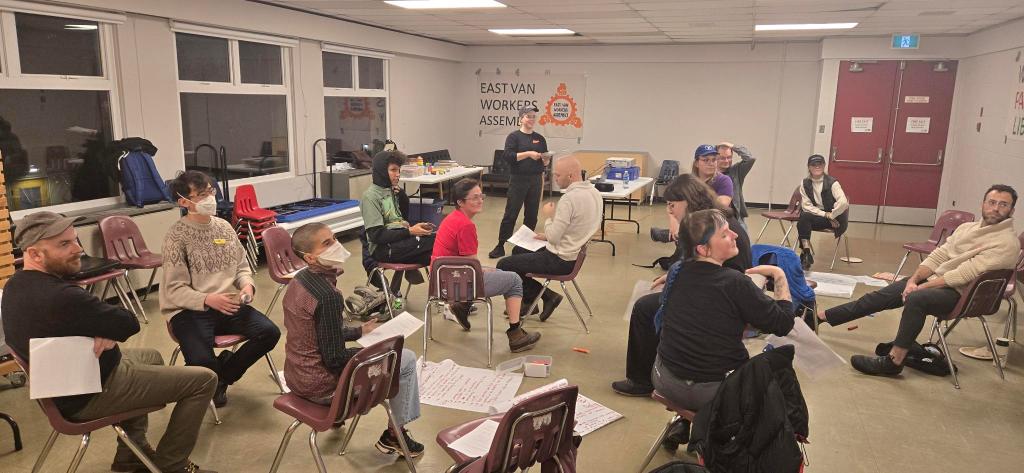
This assembly we’re beginning to discuss what we see as the basic political work we need to do to rebuild a political movement of working class people, to be able to express our power as a class through active struggle with the ruling class who exploit us for their own personal gain.
To get us moving in that direction, we propose:
Platform Point 5: Democratize the Workers Movement
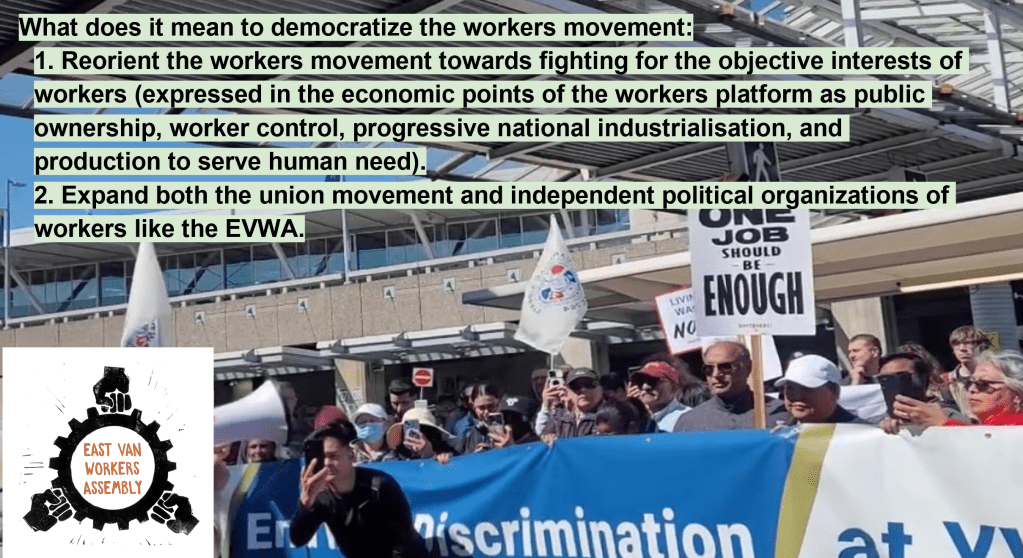
What does it mean to democratize the workers movement:
- Reorienting the workers movement towards fighting for the objective interests of workers (expressed in the economic points of the workers platform as public ownership, worker control, progressive national industrialization, and production to serve human needs).
- Expanding both the union movement and independent political organizations of workers like the EVWA.
1. What is the workers movement?
The workers movement is the conscious, organized struggle of workers for economic and political power. We contribute to building the workers movement as we agitate, organize, mobilize workers!
Workers being conscious means not only do we know we’re workers, but we can identify that we share a common class interest and a common class enemy, one which is profiting from our labour. The exploitative class structure of our society is often concealed from workers until they have the opportunity to get organized. When organizers take time to agitate, to stir up latent class anger, this combats defeatism and moves workers toward a class in itself – seeing that common class interest as reflected in workers organizations.
Organized workers exert their power through class struggle. The best combative fighting organizations and organizers of our class are honed through struggle.
While far from a complete analysis, when we take stock of the workers movement, we see:
- Overall low unionization rates in BC at 30%, about the national average. Of EVWA survey respondents, only 20% are unionized.
- There is a growing interest in unionizing, 60% of our survey respondents say unionizing would improve their workplaces.
- Combative unions such as Unite Here, the ILWU, and CUPW are or have engaged in very strong and militant labour strikes, actions, and campaigns.
- Left labor organizations like Labour for Palestine.
- Spontaneous struggles of workers for their rights like gig workers and migrant workers.
- A small but growing number of independent political workers organizations like the East Van Workers Assembly.
In order to broaden the workers movement and raise the level of class struggle we must:
- Increase workers organization: increase both unionized workplaces and independent political organization. Democratizing the workers movement requires expanding our reach and broadening our base.
- Struggle within the unions to escalate and advance our struggle – towards the objective interests of workers which is public ownership and worker control.
We need to be organized to have substantive democracy within the workers movement, and we need an organized workers movement to exert class power!
2. What are unions? How are they structured?
Unions are currently the most common form of organization in the workers movement. In its most basic form, a labour union is a collective organization built by workers to give them a common voice and vehicle for economic struggles in their workplace. Unions represent workers in relation to their bosses; make sure their legal and contract rights are being upheld; negotiate wages, benefits, rights, and responsibilities from a stronger collective position; and give workers a vehicle to assert themselves and fight the bosses and – in some cases even the government.
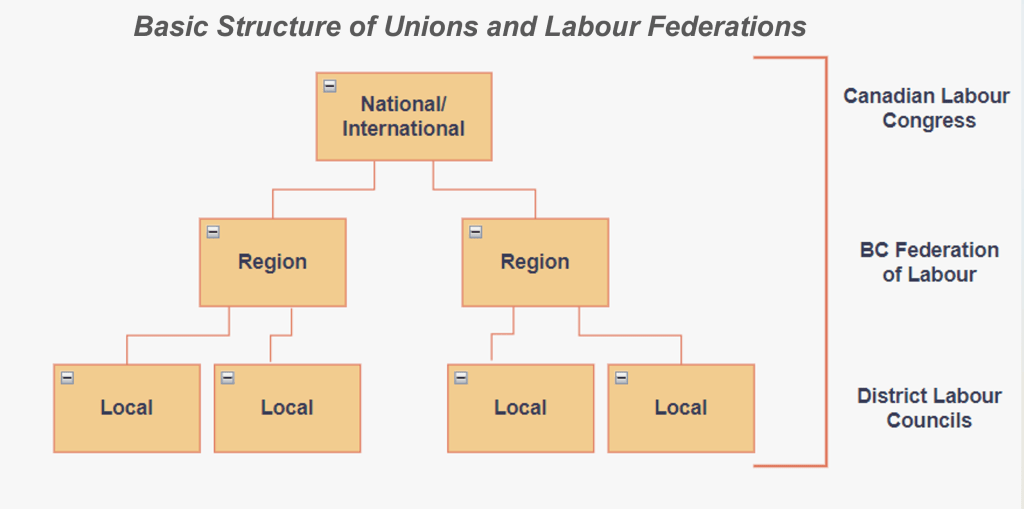
The most basic unit of a union is traditionally the bargaining unit, which is made up of all the people in a workplace or collection of workplaces who are covered by the same contract, or collective agreement. Usually, when you and your co-workers vote to unionize, you become a single bargaining unit. Next is the union local, which in most cases combines all the bargaining units affiliated with the union in a given area together. Depending on the union and the industry, there are some locals with dozens of members and there are some with thousands. Beyond that, some larger unions are divided up into regions that coordinate between the locals in their territory. For instance, the 85,000 member BC General Employees Union is broken up into 12 regions covering the province. Finally, the highest level of a union is called the national (or international, if it covers workers in more than one country).
Most mainstream unions are also connected to multi-sector labour organizations like the BC Federation of Labour or the Canadian Labour Congress. These are the largest bodies representing the union movement, but the officials leading the CLC or BCFED have little connection to worker struggles on the ground. They’re essentially political lobbyists, chasing after the NDP and even the Liberals.
While eventually we will need to build a movement that can contend for power in the highest reaches of the union movement, our focus right now needs to be where workers actually are: workplaces and union locals. The unionization rate in BC as of 2022 was only 28.6%, way down from the 43.3% level we had 40 years ago. Unionization in the private sector is even worse at just 15.5%. Unions are some of the most important tools workers have to organize ourselves and build collective power, but we can only make this happen by expanding – startingmore unions, organizing more workers – and deepening the movement. That means we can’t just have more unions, we need to actively organize inside our unions, build connections between workplaces and industries, and push for our unions to make bolder demands, take firmer stances against the bosses, and actually fight back through actions like strikes. Unions are not things that exist “out there” to file paperwork or sign contracts for us; collectively, workers are their unions, and we can and should exercise that power.
3. How have ruling class interests seeped into unions?
We want to delineate between simple ‘trade union consciousness’ and what we call ‘working class consciousness’. The reason for this is that, upon closer inspection, it is apparent that the ideas of the ruling class have penetrated the union movement. The atomization that capitalism produces extends to the working class, where several different unions will represent workers in the same workplace. The result is that many workers do not see themselves as a part of a broader working-class movement.
As workers, we have very little control over our workplaces and the fruits of our labour. Our pensions are invested in companies that reinforce the existing capitalist political structure at home. Abroad, these companies engage in imperialism (like those that aid and abet Israel). Divestment efforts are often stonewalled by government and administrative bureaucracy.
The influence of the ruling class has made some union leadership too complacent; too cozy with mainstream political parties, and too disconnected with rank-and-file workers. It is imperative that those of us that understand the importance of these unions struggle within them to raise the consciousness and level of organization of our fellow workers. If workers are to wield political and economic power, we need to recognize that no matter our profession, no matter our union affiliation, we are all part of a shared struggle, and we all have fundamentally the same interests. As one union organizer said, “Just because they are unionized doesn’t mean they’re organized.”
4. Toward working class unity and struggle that fights on both economic and political demands!
Deepening the workers movement means pushing beyond the limitations of economic struggles which often devolve into collaborative sectoral contract negotiations and cozying up to the NDP. Even our limited investigation and agitation through the EVWA reveals resentment over class collaboration and a latent desire for class struggle. We hear from workers how they tamp down their anger; there’s a hopelessness and a deep sense of resignation to the status quo when workers think there’s no point to struggle, its messy and intertwined
We want more and better organization and improved economic conditions for our entire class. But this is not enough. We see potential to both expand and deepen the workers movement through independent political organization in relationship with the union movement.
Expand through more organization! And deepen through more struggle!
5. The role of independent worker political organizations in the struggle for democracy in the workers movement.
Political organizations of workers outside of the workplace, like the EVWA, can also play a role in democratizing the workers movement by:
- Uniting and organizing workers this includes bringing in sectors with low unionization rates (or little engagement with their unions) and linking them with workers who have a developed political consciousness in a fighting movement of workers across industries.
- Developing working class political consciousness! This includes investigation into workers conditions and consciousness, and agitating workers to move politically!
- Launching political and economic campaigns. Part of our work building the platform is giving us political unity and a “guiding blueprint” as we build a campaign. A campaign from WA allows us to fight for more than we can within our individual workplaces, whether they are unionized or not.
We hope this presentation gave you some inspiration about what a democratic workers movement could look like! Now we need to continue our daily work of educating, agitating, and mobilizing workers!
The video of the presentation is below.
Our next Assembly is Sunday June 23rd.

 United in Struggle
Leave a comment