
Why the Worker’s Platform?
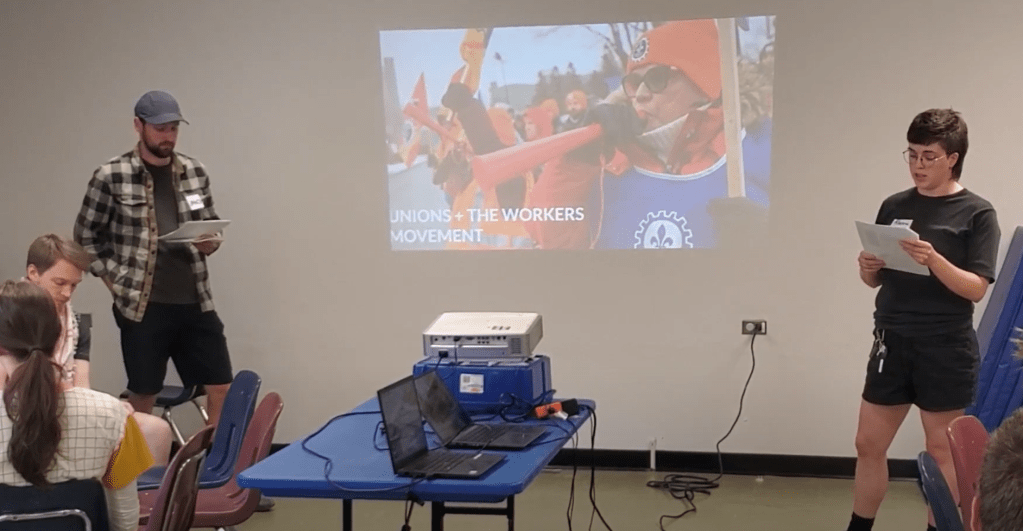
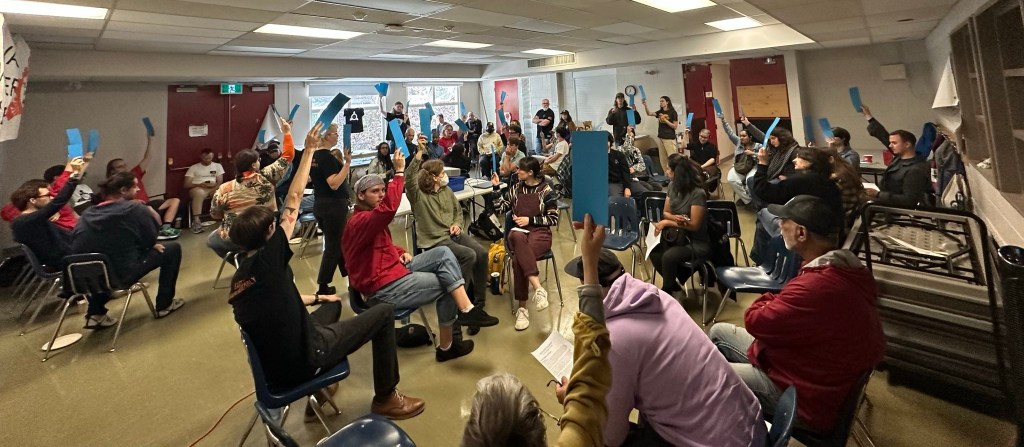
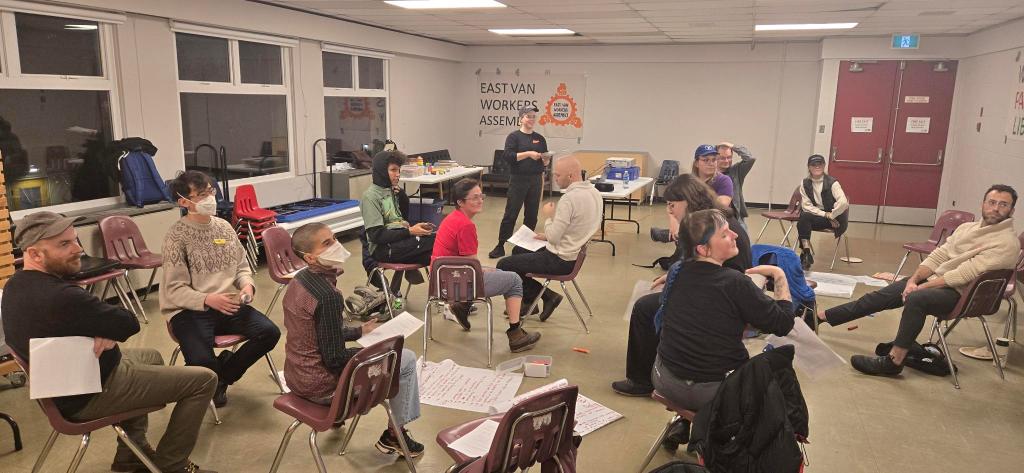
When the East Van Workers Assembly began drafting and discussing our Workers Platform at the beginning of 2024, the plan was never that this should just be a collection of interesting ideas to bat around, or that the EVWA’s purpose was simply to be a place to go every month to socialize and meet like-minded people. There are 40 or 50 workers in this room – all of us have chosen to give our precious weekend time because we know there’s something important at stake – but outside these walls there are thousands upon thousands of workers across BC and across Canada, right now, who feel in their bones that something isn’t right with our capitalist society and are ready to move, if only there was something on offer that could speak to their anger, fear, and desires. This is who the Workers Platform is for. It is a set of principles and demands, a basis of unity that we can go out with and unite workers around, a road map for the working class to direct our struggles against the big monopoly capitalists who profit from our labour and hold the reigns of power in this country.
The Platform point we worked on last month, “Democratize the workers’ movement”, is one that encapsulates a lot of what we are working towards. It’s only by unionizing unorganized workers, building up and expanding our worker organizations, and deepening the level of class struggle that we can move forward. But to do so we also have to confront one of the most significant barriers to the growth of our movement. We need unions out of mainstream political parties.
Identifying the NDP as the Problem
When people think about the activities of labour unions outside of the workplace, if they do at all, it usually has something to do with the NDP:
- Mainstream parties all have some degree of relationship with unions (even Tories, e.g. PCs/LiUNA in Ontario), but NDP has most formalized (history, affiliate unions, revolving door between party, union leadership, NGOs)
- NDP/union connection much stronger at top than at base (unions don’t reliably “get out the vote” for NDP, even among membership)
- Long history of rightward drift in NDP, especially since ‘90s (even in early years clamped down on left wing movements in party, e.g. Waffle)
We need to be clear: although the union movement is by no means perfect, it is first and foremost the NDP that is the primary problem in this relationship. Because of the NDP’s historical founding in part by the Canadian Labour Congress, the highest official union body in Canada, the NDP is happy to claim the “party of labour” title when and where it suits them. But when it doesn’t suit them, which seems to be every election cycle, they’re even happier to shrug off the most pressing demands of the workers’ movement in favour of being the voice of “small business” in Ottawa. In those provinces like BC where they actually have a shot at winning, they go even further, diving headlong into business association luncheons and backroom deal-making tours to convince our local titans of industry in energy, forestry, mining, food production, and transportation that they can be trusted to keep the gears turning and the profits flowing. The NDP is Canada’s “party of labour” only so far as a couple lines from their constitution say so, and only so long as they can continue to manipulate the bureaucratic instruments of the union movement’s highest levels. Simply put, neither the NDP nor any other mainstream party can truthfully claim to be a political voice for the working class.
We don’t have to look far to find concrete examples of the connections between the NDP and Union executives. In just a quick 30 minute search we found 9 blatant examples of top union executives in some of the largest and most prominent BC Unions that are also in positions of authority within the BC NDP. On a reddit post, a list of names of BC NDP provincial executive members were leaked. We cross referenced this list to find if any of these individuals were also staff or executives of unions. As far as we are aware, most if not all of these people hold these positions at the same time. In a few cases there is potentially a serious conflict of interest, as the Unions these people represent were negotiating contracts with a government formed by the party they represent. Comments on the Rreddit post give a sense of how this type of action is perceived:
- This is a conflict of interest. This NEEDS to be brought up big time. Isn’t this worthy of a section 12 failure to represent due to the conflict of interest?
- So where do we go from here? This is a clear conflict of interest on the part of Smith and Nederpel. You can’t represent the employees at the same time representing the employer.
- this is really bothering me, I’ve lost any faith in our union executive, things need to change.
- That’s just a bad look for the BCGEU. At the very least, she should have recused herself from the negotiations.
- when you screw over government workers who are compelled to take a mandatory oath of employment and standards of conduct review annually, EXPECT YOUR BLATANT CONFLICT OF INTEREST TO BE NOTICED! Lol
- The union needs to stay out of actual politics and stick with worker issues
This type of action creates doubt about the integrity of union executives and can often make members feel cynical about not being properly represented. When workers feel like those who are meant to represent them are just doing what’s in the best interest of the government it’s no surprise that workers feel unmotivated to get involved in worker organizing. This type of collusion and conflict of interest also fuels the opposition and validates the kind of anti union sentiment that is typical of right wing parties.

Sussanne Skidmore – President of BCFED, BCGEU executive, NDP Treasurer, BC NDP Vice President (Labour)
Jamie Matten – BC NDP Treasurer
Stephanie Smith – BC NDP Executive, BCGEU former President,
Barb Nederpel – BCFED Officer, BC NDP Executive, HEU President
Janet Andrews – BCFED Executive, BC NDP Executive, Secretary Treasurer of New West District Labour Council,
Walter Gerlach – BCFED Executive, BC NDP Executive, IAM Representative
Jennifer Whiteside – BCNDP MLA, BCNDP Cabinet Minister, HEU lead negotiator,
Brynn Bourke – BCNDP Vice President, BC Building Trades: represents unionized construction workers
Tania Jarzebiak – BCNDP Vice President, CUPE
What is the alternative then? It’s not wrong for unions and the workers’ movement to want a political center;something that can unite us, give us direction, and build organizational power around. The NDP, the Greens, even the Liberals have all tried and failed to put themselves forward as deserving of working class support, all the while rarely having the courage to even say the words “working class.” The answer we’re seeking is not outside the working class, but within it: the East Van Workers Assembly, the Workers Platform, class struggle within union locals and caucuses, other workers’ assemblies, organizations, and struggles across the country that are beginning to fight back and recognize that what we ultimately need is working class unity and working class power. It is our responsibility to build a revolutionary political voice for the working class, one that doesn’t just go to conferences with top union leaders, but actually goes into workplaces, out to picket lines, and connects with the real concerns and struggles of workers.
Why are Unions Important?
As we spoke about in the last assembly, unions are not the entirety of the workers’ movement, but they form an indispensable core that we need to broaden and strengthen, as we spoke about at the last assembly. They are the first line of defense that workers have to protect ourselves and fight for our interests in the workplace. In some of the most powerful unions historically and today, workers have extended their organization right down into the workplace, forming what are sometimes called “shop committees” on a workplace or even department by department basis. In workplaces that aren’t or can’t easily be unionized, similar organizing can still take place! This puts the organizing power of the union directly in their hands so that workers can discuss issues, solve problems, and even struggle against the boss without having to call a representative or union staffer who’s never even been to their job site before. Between workplaces, workers in a union can also build connections and coordinate activities within a local through developing caucuses that push real class struggle inside the union.
If your job is unionized, get involved, agitate with your coworkers, bring the problems they complain about to the shop steward or the union local, and don’t for one second let them brush off your concerns. If you aren’t unionized, there are issues that could unite your coworkers and move them towards organizing: better pay, safety on the job, greater say about how the workplace is run. These are just the beginning, and we can think even bigger, but to do that we need to organize inside and outside of the unions. We need to continually bring the experiences, ideas, and struggles that we find at work back to the Workers Assembly. This is where we can compare notes, share ideas, and work together to forge plans of action that support our individual workplace struggles as well as fight bigger collective campaigns that attack the big capitalist enemy and inject class struggle into the public consciousness.
What Does Working Class Power Look Like?
In order to build working class power, independent of the parties and politicians who would moderate our demands for the sake of capitalist respectability, workers need to reclaim and take control of our unions, but we also need to link them up into a larger movement that can put the economic and political needs of the entire working class on the agenda. By building connections and uniting worker organizations across the city, the province, and eventually the country around common objectives, we can push forward the fight for things like real living wages for all, an end to the kinds of “temporary” and “gig” contracts that strip us of benefits and labour rights, and even real solutions to the crises of housing, inflation, public education, and the innumerable challenges facing working class people outside the workplace. Whether on the job or in the community, at the end of the day, the problems workers face bring us into conflict with the monopoly capitalist enemy. For a better world, this conflict is unavoidable. One fight at a time, workers need to build our forces, show that we can win on the shopfloor and on the picket lines, and put forward a political vision that inspires workers to look beyond the meager political visions usually on offer.
This is the way forward. Step by step, we will prove to the unorganized workers, rank-and-file union workers, and the local level union organizers that there actually is no mainstream party of the working class. When push comes to shove, even the “progressive” NDP will betray their base for a foot in the door at the Chamber of Commerce. We say we need unions out of mainstream political parties. To achieve this we need to build the working class political alternative and prove that we will fight.

 United in Struggle
Leave a comment