
The following are speaking notes from the presentation at our July EVWA:
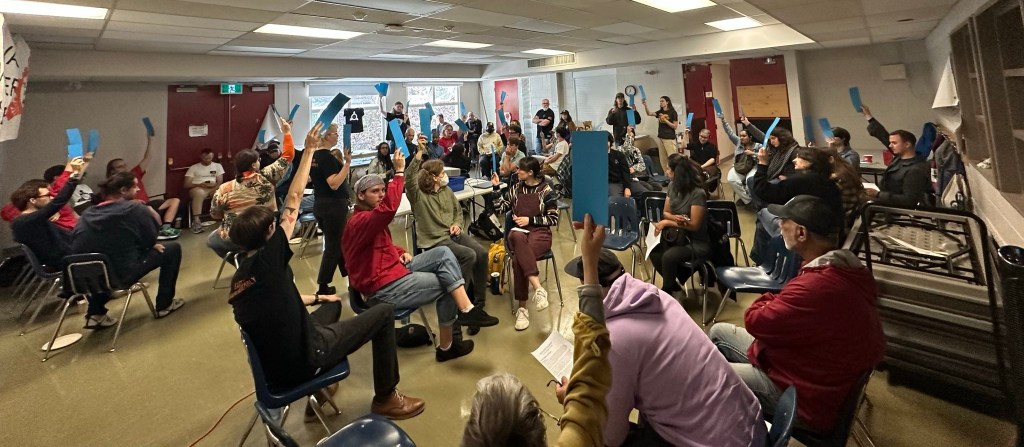
Before we start, I’m curious to know who in this room has had an experience where workplace legislation was used to improve working conditions or protect you as a worker? [just raise your hand if that’s your case] and Who here thinks that with the current legislation we are able to defend our interests as workers? There is a fundamental problem with how legislation is designed in this rigged system, and this fundamental problem is that: We are all equal under the eyes of law but the law only serves those who already have power and money. There is a really small number of people in Canada that own the means through which our system can be reproduced daily. They own the banks, the factories, the ports, they are our bosses in our own workplace. and they have thousands of employees that have nothing else to sell besides their ability to work for these parasites. the point is that we are treated as equals so that we remain exploitable. We are treated equally, but only the bosses have the political power and money that will ultimately determine how things are done in this system.
But Legislation is not all bad. Of course there are laws that try to protect us from out of the normal ass hole behaviour from our bosses. But those are only bread crumbs. And although historically it has been improving, it’s only ever been because people like us shed blood and sweat against the rich to win demands such as the 8 hour work day. But we want more than bread crumbs.
These demands won over by workers like us are used today to crush our consciousness. by making it appear that there are enough protections in place for us: to give us enough crumbs so we don’t decide to take over the mill. Ultimately, aside from the victories the labour movement has had in the past, Legislation restrains workers’ ability to fight and challenge the interests of the rich and ruling class. It puts workers organisations on a leash so they don’t lose control over us.
This isn’t going to be a “know your workplace rights” presentation. We will instead be:
- Using examples from workplace legislation to demonstrate how it prevents us from building and using our power as workers.
- Exploring how we can actually fight to win workers rights and welfare
BC Labour Relations Code:
In our province the BC labour Relations Board is the institution that hosts the disputes between workers and bosses, and based on the Bc Labour Code it will rule in favour or against workers. Employers, employees and unions can take issues to the board for grievance procedures if the labour code has been violated.
The BC Labour Code is the outline of the protections unionised or unionising workers currently have, and how individual workers or unions can carry a dispute in the workplace. And for unionised workers, it’s through the Collective agreements between unions and employers that further protections within particular workplaces are determined.
By reading over the Code, it is clear that workers and employers are treated as equal competitors in disputes, and have similar rights despite the differences we talked about earlier, emphasising bosses will always have more power than us. And there are huge problems that ultimately act as a leash and determines how far us as workers can legally struggle.
There are two examples that I think it’s important to bring to light: the first is that unions are unable to enter the workplace to talk to workers about unionising, a huge barrier to garnering support. Workers who are trying to unionise themselves are also prevented from talking about the union! It’s through conversations like the ones we have here, investigations and agitation that we are able to win workers over to the side of struggle. And there isn’t a better place to do that other than the workplace.. Labour organisers must stand outside the property and wait until the end of shifts to have these interactions, when workers are tired and want to go home.
A second example, and a very important one is that: Every collective agreement a union wins must provide that there will be no strikes so long as the agreement continues to operate (the problem with this is that it limits us to a struggle only at certain times around certain issues (usually specific to workplace-conditions), discarding the possibility of any political action from workers. It gives us the minimum to keep the system maintainable. Just that small economic bread crumb limited to something acceptable by the bosses. How can workers practice political power? If not through our worker’s organizations than we are not practicing at all) (this exemple explains that the current legislation determines the practice of political power of the working class ilegal. They will say that we can do it by voting, but electing someone in a popularity contest that was build for the capitalists and by the capitalist is not what practicing political power is. We’ve been doing that for decades and look where we’ve got to)
It’s also notable that there are also other provinces where it’s easier to form a union than in BC, such as Quebec where a union can be certified once 50% of workers sign a card, without a vote needing to happen.
Employment Standards Branch
Now, similar to what we just talked about with the labour board and the labour code, we also have the employment standards branch and the employment standards act. Employment Standards Branch, similar to the labour board, is the court that rules based on the employment standards act. If you realise your employer is violating the act, you can file a complaint at the Employment Standards Branch (ESB). The problem is that there are only 8 locations of the branch in BC, so good luck with that. the process can take several months because it involves investigations that often leads to shit. An investigation means your employer will be informed, and you, as the worker, will be identified. They basically do the favour of telling the bosses who their enemy is. This puts the worker at risk of harassment, including lost hours or termination. And if someone files for a worker as a third party, they are cut off from receiving all the information about the case.
The Employment Standards Act (ESA) applies to non-unionized workers (and unionised workers unless their collective agreements cover more) but includes some substantial exceptions. For example, it doesn’t apply to independent contractors, and many workers can fall within this category. If I’m not wrong I believe I’ve met some of you in the assembly that would fall under this category and already know what we are talking about.
The Act maintains the profits of our bosses while keeping us in shit conditions. For example, under the act, we only get 5 paid sick days a year and even then only if we’ve worked 90 days in a row. Before 2022, we got none. And we still get no paid time off if we are caring for a sick family member or have a death in the family. Applying for EI or medical EI is an option for emergency circumstances but it is only, at maximum, 55% of our income. For low wage workers, this simply isn’t enough to survive on. And these are only in place so employers don’t have to pay what they owe us.
The Employment Standards Regulations is essentially a legal guideline of how the Employment Standards Act is regulated. It includes variations on minimum wage, making it even more exploitable. For example, agricultural workers being paid per amount picked which, for example, is only $23 per 27 cubic metre.
The rap team conducted some investigation this past couple of weeks and found out interesting examples of workers getting fucked by the employment standards branch.
It took 2 years for a worker outside a warehouse we spoke with last week to receive the rejection of his complaint at the branch (which was a result of his boss stealing 30% of his wages and admitting this). Sometimes complaints are even longer, upwards of 3 years and they are always up to the judgement of an Officer and their biases.
You can appeal Employment Standard Branch decisions at the Employment Standards Tribunal but this is also a slow and bureaucratic process. The worker with the 2 year long complaint told us he felt like he needed a lawyer for it and who can afford that?!
On top of being a dead end road to bureaucratic hell, individual workers fighting individual attacks through complaints to the branch simply isn’t building collective worker power. After a long and exhaustive fight, a worker still might lose. The Branch and Tribunal not only zap us of our energy but funnel our anger into these individual disputes. Even if we win at the branch, we won’t actually ever win a workplace with our interests in mind. We need a much bigger fight for this – a fight which starts right here in this Assembly. We know in this room that it is only the power we exercise which will get us what we want. Growing our numbers and starting our Fall fighting campaign, rather than catering to weak ass legislation will put our enemy in the hot seat – exactly where we need them.
WCB/WorkSafeBC (and BC Human Rights Tribunal)
The Workers Compensation Board (what we call WCB sometimes), operates as WorkSafe BC, and exists as one of the 6 largest crown corporations in BC. In 2022, the CEO earned $365,068. One Van Wholesale Produce worker told us that dealing with WorkSafe made him feel like he was being accused of lying, which is why he called WorkSafe bloodsuckers. This worker had only been able to take 6 paid months off after what appears to have been a major head/neurological injury. He woke up in the hospital and that’s all he remembers from it. When he returned to work, his boss unsurprisingly was an asshole. Since he wasn’t able to take more paid leave through WorkSafe, he was put on evening shifts as his injury has made sleep really difficult.
WorkSafe was created as a “historic compromise” to benefit workers and employers. Much the same as Employment Standards Branch complaints, WorkSafe complaints cannot be made anonymously. This puts the worker at risk of retaliation by the boss, particularly worrying if the complaint is about harassment. Furthermore, WorkSafe BC complaints are predominantly approached on a case by case basis and don’t look at the systemic nature of violence in the workplace. They also don’t really do anything to lead to changed workplace conditions. A worker could file a complaint and even if the investigation leads to compensation, the employer could keep on doing the same thing.
Employers are responsible for investigating incidents or near-misses that take place in the workplace by submitting investigation reports to WorkSafeBC, so basically it’s on our bosses to look after our safety. And WorkSafeBC states that it MAY investigate workplace incidents which is a half ass promise of protection. They MAY investigate? Why not HAVE to investigate?
We can file a complaint with the Human Rights Tribunal if we are being discriminated against at work (race, ability, gender, sexuality etc.) but this also does nothing to challenge the system of profits being made on our backs. Our bosses will continue to create working conditions to maximise their profits even if we give them a slap on the wrist through this tribunal.
The Temporary Foreign Workers Act allows bosses to make more profit. The legislation limits migrant workers’ collective power by forcing workers to accept shittier pay and conditions under the hopes of PR and/or citizenship, something which rarely happens. In the example of migrant care workers, PR was less than ⅕ of the targeted amount. And migrants outside of the Temporary Foreign Workers Act are extra exploited too, and aware of this exploitation as demonstrated by one of our comrades’ co-workers in a fish factory who said: “We are just workers who can’t speak English good, we cant want lot or get sick much or they no need us”.
And migrant workers being denied wages and good working conditions happens all the time – such as the over a hundred Guatemalan farm workers who had $131,631 stolen from them collectively in 2018!
DISCUSSION QUESTION #1:
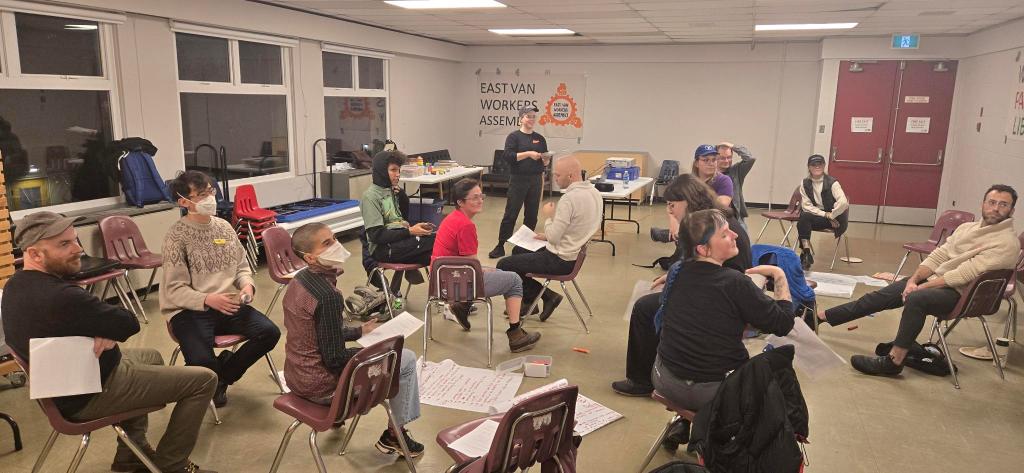
What are your experiences with the limitations of employment law in your workplace?
How we fight:
So despite having just had some important conversations about the pitfalls of worker legislation, we want to emphasise that it’s not bad to fight for compensation. It is even a point of consciousness-raising. But what do we do to actually win the advancement of workers’ rights and welfare? Our struggle has a 4 step scientific method: investigate, agitate, organise and mobilise.
We start by investigating: finding out the challenges that the workers who are not in this room are facing. If you’ve been to previous Assemblies, you’ve probably heard us talk about RAP: Research, Agitation and Politicization. We make investigation a reality and invite you to join us! Our research is done by regularly asking other workers about their working conditions, as awkward and uncomfortable as conversations with strangers might feel. There is a wealth of knowledge within the working class. Planning campaigns, including our upcoming fall offensive, is best done when we can see how issues are playing out in peoples’ lives and workplaces.
A delivery driver told us recently that he would join us but only once we reach a million members. So how do we build the level of worker power to get to a million? If we aren’t putting ideas out there which workers can relate to, and talking about things that make us all angry, then we aren’t going to be able to bring in more workers. And we’ll continue to be the small potatoes the delivery driver told us we are.
So agitating with workers is our next step as it allows us to grow the Assembly and build our numbers. These are both necessary urgent and tasks for our upcoming campaign. We’ve grown up in a rigged economic system and taught wrong ideas, so it isn’t surprising that we hear phrases like “it is what it is” or “at least I’m not living on the streets” when we investigate. In our conversations, we challenge other workers to think about our power. Enough small potatoes can crush whatever stands in its path.
And we truly build this force by organizing, our third step. This Assembly is a space for us as workers to do what we want with it. Fighting must first come from a place of unity, which is why we’ve spent the past year building a Workers Platform through investigation. We’ve gone over the past 9 points with Assembly attendees, taking time to discuss and learn from each other and really think about what it means for us to be an active Assembly! Participation and engagement from every worker is our goal!
So we invite you to join us for our fall campaign as we will be mobilising. So far the Assembly has been mobilising our numbers to support the Sheraton workers at their site of class struggle as the SWAT team. However, we will be launching our own offensive which will be fighting for our comrades on that picket and beyond! And if we want to win, we need workers in this room and outside of it to bring what they can to the fight!

 United in Struggle
Leave a comment