
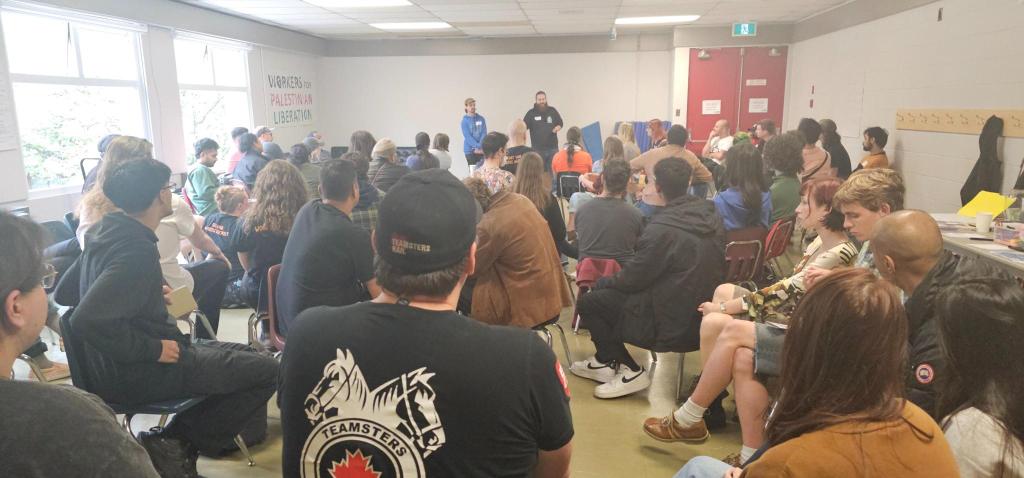
In September the East Van Workers Assembly launched the Bosses Behind Bars campaign.
Employers say they take all the risks, but when EVWA organizers talk to workers, we consistently hear stories of workplace strain, accidents, and injuries. Many workers are in difficult and demanding jobs where they face the threat of physical injury from unsafe conditions, and mental strain and psychological injury, too often as a result of bullying and harassment from their bosses. Physical and psychological injury, the speed-up of workers leading to dangerous conditions, and the threat of bullying and harassment from employers reach across the public and private sectors, across production, distribution, retail, and services.
Workers in the East Van Workers Assembly demand the government hold bosses accountable for workplace safety conditions, injury, and death. Our demand to hold employers accountable unites workers and their unions on a strong and militant call, with concrete demands, and a clear target against big business owners.
Workers’ physical and mental safety is a class struggle! It is time for all workers to take up the struggle against the bosses and hold them accountable for the deadly conditions they place us in every day.
Check out our campaign overview #BossesBehindBars!
Who are the workers in the public sector?
Approximately a quarter of BC’s workers are in the public sector, a massive sector of the working class.
Commercial Crown Corporations
Workers at BC Hydro, ICBC, the BC Lottery Corporation, and Canada Post are examples.
Crown corporations that deliver services receive all or most of their funding from the government. Examples include workers at BC Housing or Destination BC.
School Districts, Public Post-Secondary Institutions, and Health Authorities
They receive government funding and can collect fees for services.
Examples include teachers and staff at Langara College, the University of British Columbia and the Vancouver Coastal Health Authority.
While many public sector workers work directly for the government, the government uses privatization to keep non-profit organizations far from them. They can pay these workers less and exploit them further. Non-profit workers are also part of the public sector! Through privatization, the government saves money by further exploiting non-profit workers while washing their hands off the issues that arise, claiming to be no longer responsible.
Injury, deaths and who is responsible in the public sector, here’s what unions in this sector are saying:
BC Teachers Federation (BCTF) says only a third of teachers find their workload manageable. In a recent membership survey, one of the key themes was that teachers were expected to do more with less. In the report, they referenced a worker who shared how “coworkers have heart attacks, lose their pregnancy, [are] on medication…because of what this job is doing to them. It’s disheartening thinking that we will break before anything is fixed.” Teachers’ mental health continues to be affected by inadequate staffing and resource provisions, intensified workload, challenging workplace culture and insufficient support. The BCTF highlights the normalization of the increased exploitation of teachers, forcing teachers to take on more work over time.
The BC Nurses Union (BCNU) is close to becoming the first province in Canada to establish minimum nurse-to-patient ratios, setting a global precedent with a staffing standard of one nurse for every four patients in medical/surgical units, 24 hours a day. The Ministry of Health is working on rolling out this initiative in phases aimed at better patient care and improved working conditions for nurses across the province.
The BCNU has recognized that women are more likely than men to decline musculoskeletal injury claims. It is also working to change the language in Worksafe BC legislation to support its workers more equitably. While the minimum nurse-to-patient ratio is an important initiative, it does not support any other type of worker with staff-to-patient ratios. The BCNU is known to raid workers from other unions and fight for the rights of nurses solely unionized through BCNU as opposed to nurses across the province. While the fights of unions individually are important, we need to fight as a class to win rights for all workers.
The Canadian Union of Public Employees (CUPE) announced in June that the BC Ministry of Labour added 11 new occupations to the mental-health presumption under the Workers Compensation Act this week. This will allow more CUPE members faster access to treatment and workers’ compensation benefits for psychological injuries. This presumption was previously only available to police, firefighters, paramedics, sheriffs, and correctional officers. While this change is needed, we know that CUPE workers have significant challenges having their claims approved on time, leaving many workers unpaid for months waiting to be approved.
Since the initial implementation of Postal Transformation in 2010, the Canadian Union of Postal Workers (CUPW) regularly heard from members about increased stress, increased overtime, loss of day shifts, changes to work hours, and fewer opportunities for job rotation, transfers or promotions. When researching this issue, they found that over half of women said they were less safe at work, and ¾ of them said they fear potential violence at work more. Over half of all respondents said they were more angry at work. 89% of external workers said that their level of fatigue and aches and pains has worsened since the postal transformation. 2/3rds of them said their frequency of workplace injuries has increased.
We can see how unions are raising the issue of workplace injuries as necessary in their workplaces. We hope to unite workers across unionized and non-unionized workplaces around some common issues: workers being increasingly exploited and facing increasing risk of injury at work.
Psychological Injury
Many of the above unions highlight how psychological injury and stress impact public health workers. Since our campaign launch, we have been talking to workers in the public sector who are fighting on this front. Workers have told us they are being forced to carry such high work burdens that it brings workers to the breaking point, winding up on medical leave. As staff leave, even more work is piled onto the remaining workers. There is very little to support the work’s sustainability, with workers being exploited for their care for the job or support for others. Many staff respond to daily overdoses and support and care for people who are experiencing complex trauma, mental health and addiction. We have heard from workers that it can take months to be assessed and approved for psychological injuries at work. They often feel they need to prove themselves to Worksafe to get compensation for lost work or counseling benefits. Many staff are forced to make financial decisions about being off work unpaid instead of taking the time off they need.
While increased work and stress are not unique issues to the public sector, they are unique because the public sector is one of the only sectors where they are discussed in this way. While many workers may end up burnt out, many other industries do not have the same language or protections around psychological injury.
The public sector has been key in identifying how their workplaces put them at increased risk for psychological injury as their workplaces continue to squeeze them for increasing amounts of stressful work.
Who is the Enemy?
The big monopoly capitalists depend on public service workers to guarantee that workers are calm enough for them to make profits. But, in times that capitalists need, they will direct the government (being the NDP, Liberals, or Conservatives) to slowly privatize these services to open new frontiers for profit making and/or drive wages across the labour market down. Ultimately, it is up to us to unite as a class to force our interests upon the governments.
While public sector workers continue to grind, with their working conditions getting worse and their chances of injury increasing, we need a united working class to fight back!
The East Van Workers Assembly works with unions to build worker power, fight the big bosses, and improve working conditions for all workers across the worksites, industries, and sectors.
Join Us!


 United in Struggle
Leave a comment