
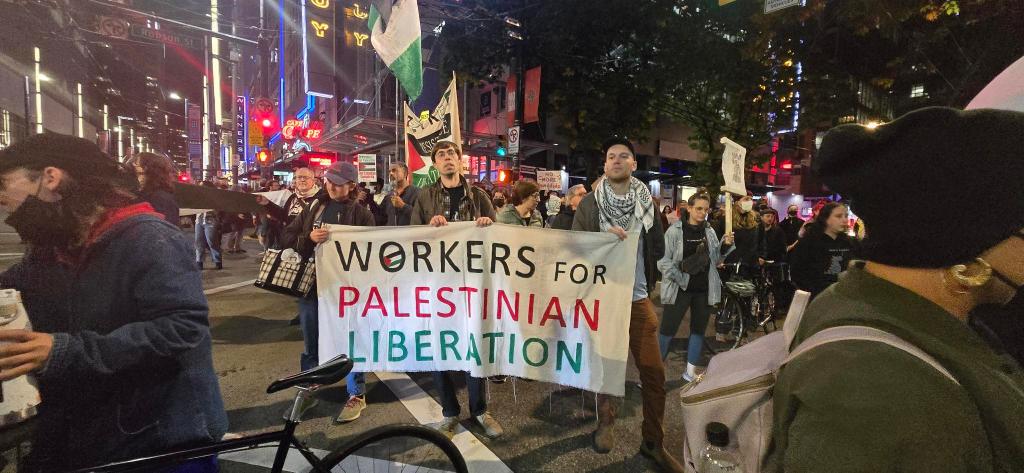
From the Picket Line to Palestine: We need to build resistance to State Repression into the DNA of our movements!
State repression is the response of the ruling class whenever people’s movements break through the boxes of allowable conflict that they’ve shaped with their class monopoly over the law, mass media and the other institutions of capitalism.
The designation of Samidoun as a ‘terrorist entity’ by the Canadian and U.S. governments is a case in point. The swelling movement against the genocide in Gaza, in support of Palestinian liberation, and against Zionism and the Israeli State, quickly burst through the long established and maintained box on ‘international solidarity’ which allows for symbolic demonstrations of concern about human rights, but not questioning the legitimacy of the Canadian State, its foreign policy, or showing support for those who resist Anglo-American imperialism.
The Palestine solidarity movement, especially in early 2024, exposed the profound disconnect between the position of the Canadian ruling class and their political establishment and the majority of people in this country. While the ruling class and their political representatives have remained in lock-step support of Israel, despite some mild ‘human rights’ window dressing, the majority of people in have come to support Palestinians’ right to self-determination. And a significant minority of the population openly support Palestinians’ struggle for national liberation, and understand this struggle as being diametrically opposed to the Zionist colonial project of the Israeli State.
Samidoun’s role in the solidarity movement, of clearly supporting the Palestinian resistance and upholding the right of an oppressed and colonized people to resist by any means necessary, put them clearly on the other side of the line of allowable (i.e. non-threatening to the system) politics, and in the cross hairs of the Canadian State. The arrest of Samidoun’s international coordinator Charlotte Kates, on bogus charges of “inciting hate”; the designation of the organization as a terrorist entity; and the subsequent violent raids and detainment of people associated with Samidoun, were clearly an attempt to remove Samidoun’s principled and militant political leadership, and to put the movement back in the box.
Containment: putting peoples’ struggles in a safe box
Criminalizing people for speech, political affiliation and for political positions is not the preferred option of the ruling class. They would rather that we just stayed in the boxes they’ve created where we pose no threat to the prevailing order of exploitation which is their lifeblood. And the boxes they’ve created are very sophisticated.
Support for National Liberation and Anti-Imperialist Struggles Abroad
Within the Anglo-American Imperialist Alliance (AAIA) of which Canada is a part, the criminalization of support for peoples’ national liberation and anti-imperialist struggles goes back to 1997 when the U.S. created a list of “Foreign Terrorist Organizations” that included mostly leftist groups involved in armed struggle, and notably every major Palestinian faction and political party that had rejected the Oslo Accords’ path to capitulation, collaboration and a puppet Palestinian Authority that acts as a wing of the Israeli occupation.
In the wake of 9/11, the U.S. list was expanded and the model of terrorist designations was exported to imperialist and reactionary states around the world. The inclusion of a handful of reactionary organizations, many of which are sponsored by states which are themselves supported by the AAIA, made for an extra source of confusion and cover for a list aimed at revolutionary and anti-imperialist movements.
In this country, vibrant movements that were once able to mobilize political solidarity and material resources for revolutionary struggles abroad were shut down or forced underground. An active movement in solidarity with revolutionary forces in Colombia effectively liquidated itself when the FARC-EP and ELN were both included on the list. And, in the wake of the 2009 genocide of Tamil people by the Sri Lankan state, when the Tamil community in Canada rose up in mass mobilizations that blocked infrastructure and seriously disrupted business as usual, they faced police repression and a crack down on organizational links and financial support to the main organization of their national liberation struggle. The post 9/11 war on terror created a political chilling effect in communities who’s national liberation struggles were listed and targeted, but also on the broader political left where a hesitancy to talk about or identify with armed liberation movements suddenly became prevalent, leading to conservatism in public discussion about international politics and opening ground for liberal, charity and human rights frameworks to dominate the discussion. In this context the right wing narrative of ‘Islamic terrorists’ and ‘extremists’ to characterize movements resisting imperialism became the norm, and the actual demands, vision and strategy of revolutionary movements of oppressed people fell off the radar.
Samidoun’s upholding of the legitimacy of Palestinian armed resistance, and specific support of the organizations leading the Palestinian resistance, broke out of the confines of that chilling effect and was inspiring to many, especially young people who had grown up in the political fog of the war on terror. While these political positions are not technically illegal under Canadian law, they raised a real ideological threat to the Anglo-American Imperialist Alliance, and led to the state repression leveled against them.
In the broader context of the Palestine solidarity movement the Samidoun terror designation should be seen as one point, and an important one, denoting a particular boundary, on a continuum of repression that includes spurious charges and harassment at demonstrations, bogus ‘hate speech’ charges, firings and workplace discipline for speaking out, and the general chill on talking about Palestine, all intended to contain the movement.
Militant Workers Struggles
The containment of workers struggles has a longer history in this country. In the 20th Century, the Russian revolution, the Winnipeg General Strike, and the general militancy of working class struggles in the interwar period forced the ruling class to evolve a containment mechanism. This box on worker’s struggles codified some important rights for unions including closed shops, dues tick off, and anti-scab laws, while simultaneously creating a rigid legal framework that could hold back unions from political and solidarity strikes and funnel their political activity into reformism and electoralism.
In those few moments when workers’ struggle has threatened to break out of the boundaries of legalism and an employer-friendly collective bargaining regime, the state has not hesitated to unleash serious repression. The outstanding modern example is the Quebec General Strike of 1972, in which the state jailed hundreds of workers, including the leaders of the three main trade union federations, and levied huge fines. And the 1978 postal workers strike when the Canadian state jailed Canadian Union of Postal Workers (CUPW) president Jean-Claude Parrot for refusing to send workers back to work.
With the growing tendency toward threatening, intimidating and finally legislating striking workers back over the past two years, it seems that the Canadian bourgeoisie, in its desperation to maintain and expand its pool of profits, is willing to undermine the legal regime of labour management that has worked so well for them over the past 80 years, leaving workers with the question: when will we shrug off this shell game, demand the real value of our labour and break free of the system that only works for the bosses? When we do, we will undoubtedly have to deal with state repression.
Indigenous Struggles for Self-Determination and Liberation
The very basis of the Canadian State’s existence is the containment of Indigenous struggles for self-determination and sovereignty. The main instruments of containment have been treaties – asserting the legitimacy of Canadian control of the vast swath of Indigenous land – and the Indian act – as a tool for defining membership in Indigenous communities and creating and controlling the mechanisms for governance of Indigenous people and reserve lands.
Struggles that expose the illegitimacy and injustice of the Canadian state’s control over Indigenous lands – like at Kanesatake (Oka) in 1990, Ts’peten (Gufstafsen Lake) in 1995, Kanonhstaton (Caledonia) in 2006, Elsipogtog in 2013, Wet’suwet’en in 2019-2020 – are met with militarized state violence and criminalization. The policing of these types of Indigenous transgressions of the boundaries of allowable political action are woven into the whole institution of Canadian policing and the security state and built on top of the layer of ‘regular’ racist policing and mass incarceration of Indigenous people in this country, which functions as a baseline of containment.
But there’s also a whole other layer of containment related to funding: Indian Act institutions and treaty negotiations that set the parameters of allowable political activity in Indigenous communities. These institutions, bolstered by the rhetoric and run-around of the Reconciliation industrial complex (the new strategy for assimilation), steer Indigenous leaders and activists away from a more militant politics that would necessarily bring them into contradiction with the Canadian state, but would also open up the possibility of substantive liberation, and not just a process of incorporation, on more ‘equitable terms’, into Canadian capitalism.
Some Rules for Resistance
Clearly we can’t make the kind of changes we need to without fighting outside the box our enemy has put us in! But revolutionary posturing, left adventurism and utopian small-groupism (anarchism) don’t actually get us anywhere. Unnecessary sacrifice, and actions that escalate the contradiction with the state when we’re not prepared to defend ourselves from the inevitable repression, don’t benefit our cause. Building our political base and solid work among the masses is a pre-condition to escalating our contradiction with the state, which should come when we reach a quantitative threshold of organizing that allows us to win gains, consolidate our position, and reach a higher stage in our struggles.
Some guidelines for building the resilience and adaptability to repression that our movements need are:
1. In all times, in all places, the support of the masses is our most important protection against state repression. The masses, in our context the multi-national working class and Indigenous popular classes, are the material force that can contest the power of the imperialist bourgeoisie, and the thing that they are really afraid of. So the first principle is to use the best tools we have for organizing, inherited from the world’s most advanced revolutionary movements – step by step organizing and the mass line – to build a mass base. Mass line is critical here, because it guides how we articulate our politics: it’s not conservatism – we must be bold with our politics, push people’s consciousness and be fearless in the face of our enemies (Makibaka! Huag Matakot! Fight! Don’t be afraid! as the Filipino movement teaches us) – but it’s also not adventurism – giving expression to our most revolutionary and militant aspirations only exposes us to state repression if we can’t bring the masses along with us.
2. We need to build and practice collective leadership. Not ‘horizontalism’ which just obfuscates leadership, and acts as a barrier to getting organized, but structured leadership based in collectives and committees, and consciously training second, third and fourth line leaders who can step in when existing leaders age out, move on, or are removed by the state.
3. We must put in place security practices that are consistent with the current level or repression and maybe a bit more, but without falling into the trap of getting closed off or paranoid in ways that alienate and distance us from the masses. The watchword here is minimal exposure to the state, maximum exposure to the masses. We should have people in our movements who understand the surveillance technologies and strategies of the State, but we must keep in mind that there is no technical or technological solution to the problem of bourgeois state repression, only working class power can solve that problem.
4. Without getting sidetracked from our main task of organizing the masses, we should take advantage of all civil rights and legal avenues open to us in resisting and contesting state repression. However we should never lose site of the fact that legal venues are the terrain of the enemy, and any victories there will be temporary and conditional. Our main contestation should be linked to mobilization of the masses through consciousness raising, mass political campaigns, and prisoner support work.
5. We should build unity across movements and struggles on the principle of standing together against repression. Don’t pile on when groups face repression, even if we don’t agree with them on everything. Keep criticisms internal and principled. Don’t use language that justifies repression. Don’t divide targeted groups into quote ‘real terrorists’ and ‘unfairly designated’. Call for the terrorist list to be scrapped, it is only and always has been an instrument of imperialism!
How do we stop the crimes of Canadian imperialism?
Canada’s active support for the genocide in Gaza and its repression of the movement against it, are yet another reminder of the thorough rottenness of Canadian imperialism. With a ceasefire in place, the Canadian ruling class, political establishment, and the whole Anglo-American Imperialist Alliance will be seeking to rebuild their boxes of containment internally, and continuing the normal plunder of oppressed nations and grinding exploitation of workers around the globe.
If we truly want to stop Canadian imperialism’s support and participation in future genocidal wars, we need to get serious about organizing, and linking, the two big forces in this country that can confront and defeat the Canadian monopoly bourgeoisie: the multi-national working class fighting for socialism, and the oppressed Indigenous nations fighting for self-determination and liberation.
If we do this work effectively we will face State repression, but as the Palestinian people have shown over the last 15 months (and last 77 years!), even the most brutal and genocidal attacks of imperialism cannot defeat a people united behind the struggle for their own liberation.
United in Struggle Planning Committee, 2025-01-28

 United in Struggle
Leave a comment