
Botond from North Star Media
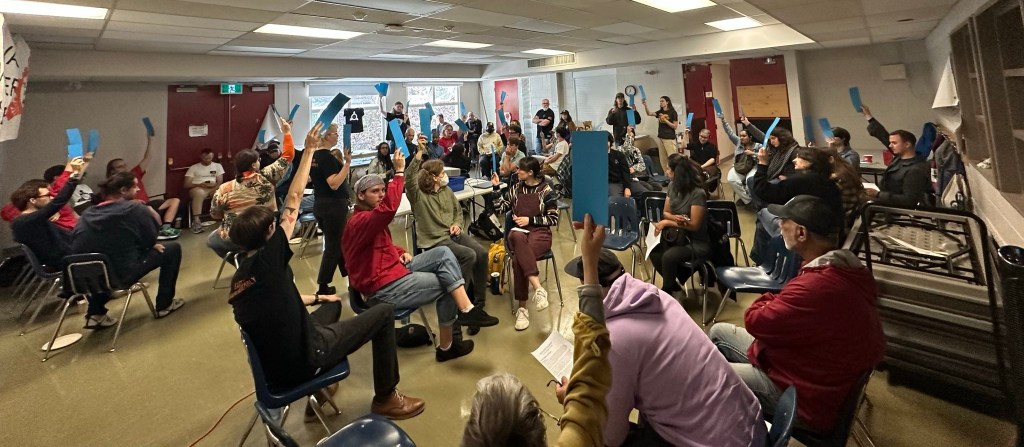
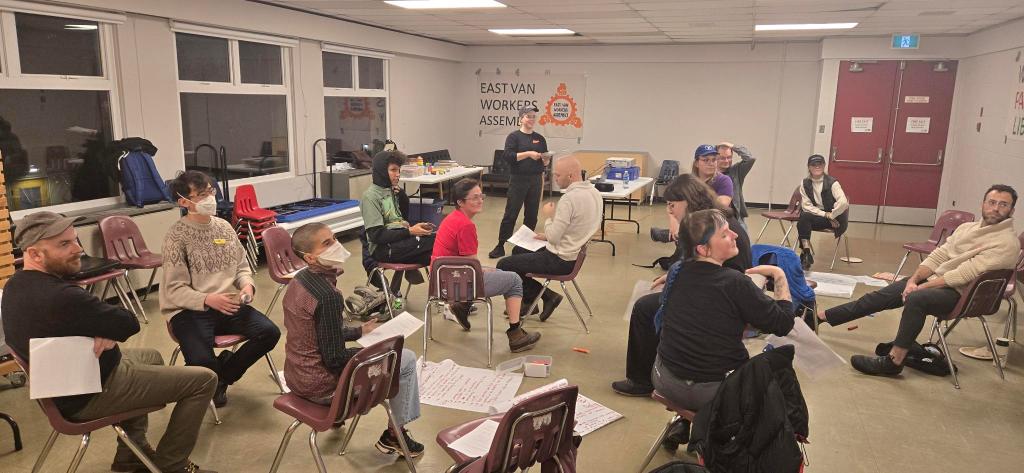
Reporting from North Star at the East Van Workers Assembly
January 26, 2025
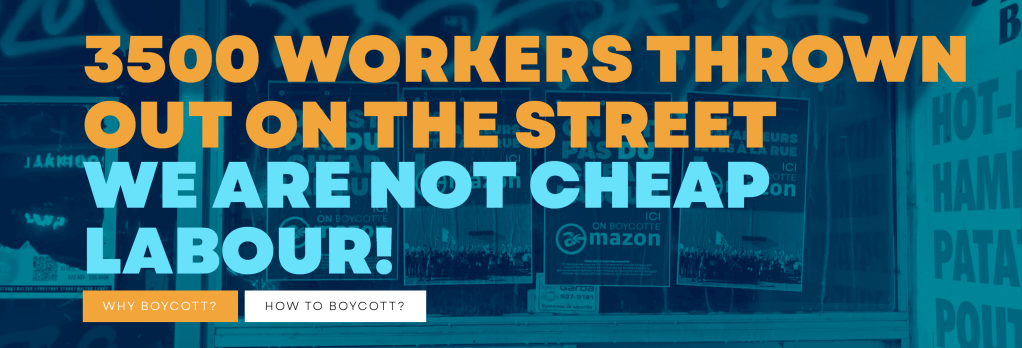
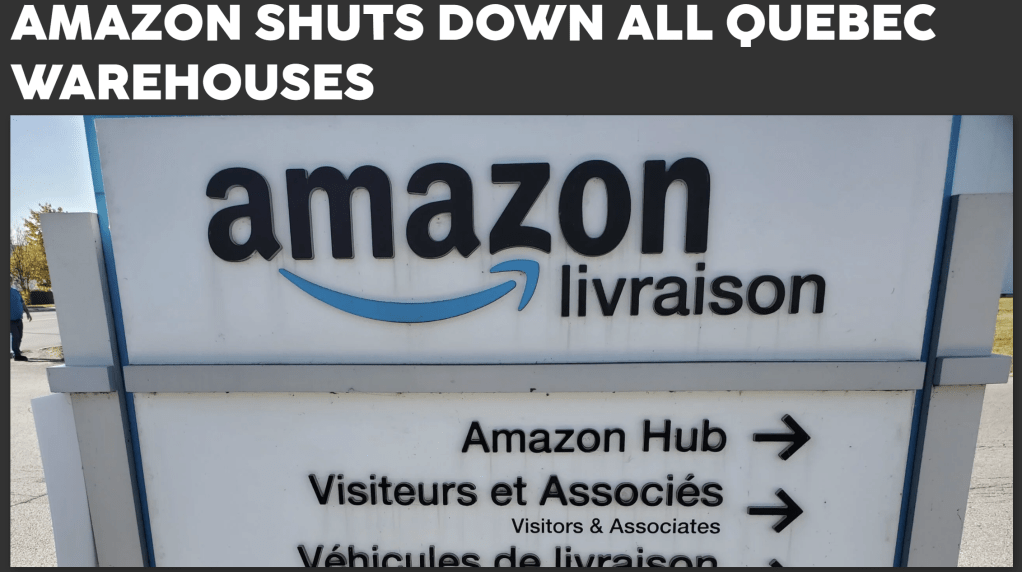
As you hopefully have heard, earlier this week on Monday morning, Amazon announced it will be permanently shutting down all Amazon warehouses in the province of Quebec which will lay off over 3,000 workers in the next two months. Keep in mind that, though Amazon says this has nothing to do with it, we must emphasize that the DXT4 warehouse in the province of Quebec was the very first in the country to successfully unionize after a long struggle to do so.
Unionized with the Confederation of National Trade Unions, the second largest trade union by membership in Quebec, workers placed themselves in a very powerful position against Amazon, being able to mobilize around 300,000 members if needed.
After the 2022 holiday season, North Star released an investigative report detailing how the holiday shopping rush affects the health of Amazon warehouse workers, finding that at least 40% of all worker deaths in Amazon warehouses around the world occur during peak season. 20% of those deaths being heart attacks, a former package sorter explained that when working in the back of trucks, inside the enclosed space with the boxes and the conveyor belt, it gets really hot. If the weather is hot and, additionally, humid, it’s even worse. François, the worker quoted in that report, said he experienced a hard time breathing and heart palpitations as well. Rafael, a worker and father of four in New Jersey died while sorting in the back of an Amazon truck, and other workers have reported experiencing similar conditions as what took Rafael’s life. In one case, at a fulfillment centre in Colorado, workers reported that they were made to work within 10 ft of the body of Rick Jacobs, a 61-year-old worker who died of a heart attack and managers covered with boxes. Year after year, Amazon’s fourth quarter has always been the most profitable. The average yearly increase in net revenue between their third and fourth quarter over the past five years has been 30%. In 2021, their net revenue from the third quarter to the fourth quarter went from 110 billion to 137 billion, a 27 billion dollar growth. Taking this into account, pay attention to the timing of the current warehouse closures being after the end of the year.
As told by an employee working in Amazon’s HR department, HR is trained to question the workers who have been injured on the job and find flaws in their stories. Were they drinking the previous night, if they used drugs, if they got enough sleep the night before, anything to take the accountability off of Amazon. And, if they don’t find anything, the next step is to get the worker to quit, to push them out the door. In the U.S., serious injury rates in Amazon warehouses are 6.8 per 100 workers, which is more than double the rate at non-Amazon warehouses in the country. The reality in Canada is worse, injury rates in Canadian warehouses were 15% higher in 2019 than the corporation’s U.S. Average.
In 2023, North Star reported on Amazon workers’ wages shrinking as compared to inflation. When comparing wages to inflation, it becomes clear that the purchasing power of Amazon warehouse workers fell by ONE DOLLAR and EIGHT CENTS per hours worked. That means, with the entry-level wage being $17.60 when the first sorting centre opened, and wages being at $19 at the time of the report, wages should have been, at the very least, TWENTY DOLLARS and EIGHT CENTS an hour. And that’s the very bare minimum. For reference, the median wage in Quebec in 2022, so the year previous to when the report was released, for this job category within the same economic sector was $21 per hour.
Since even before unionization, Amazon has been fighting the efforts of workers to organize themselves. Workers in Quebec fear even being seen engaging with people from unions, weary of reprisals. Their shifts getting cut, getting reprimanded, or even fired. Miguel and I saw this first hand while doing social investigating at the Braid station Amazon warehouse, lots of the workers’ first question was “Are you from the union,” and they really didn’t want to speak about anything at all unless we assured them that we were only there to ask questions about their workplace and are not connected to any union.
A little tangent, but locally back in the summer, Unifor had to withdraw their application to have two warehouses union certified from the BC Labour Relations Board TWO minutes before the scheduled certification bid because Amazon, suspiciously, reported a higher number of employees than previously expected by Unifor. Meaning Unifor wasn’t confident they were going to have the sufficient number of signatures to unionize the warehouses, suspecting Amazon of, most likely, having hired a large number of workers very quickly so the workers wouldn’t meet the sufficient percentage of votes to unionize.
Anyways, back to Quebec.
May 10 of last year, from the moment Amazon’s DXT4 warehouse got its union certification, Amazon immediately declared that they did not recognize the union and that they were contesting an article in the Quebec Labour Code that among other things, forces the employer to negotiate with a union that has obtained signatures of membership cards by the majority of workers it seeks to represent.
In a communication sent privately to all employees at the DXT4 delivery centre, Amazon claimed that the court had certified the union “without allowing a vote.” They added that they want to appeal the decision, saying they were QUOTE “ensuring that the laws respect the right of every individual to be heard and to decide what is right for all of our employees.” END OF QUOTE. Yet more than 50% of Amazon workers signed a card, the same percentage as is required in a vote. In October of last year, Amazon’s challenge against the Quebec Labour Code was dismissed by the courts.
Amazon has spent millions of dollars hiring anti-union consultants. In 2022, the year that saw the first successful unionization of one of its warehouses in Staten Island, Amazon spent US$14 million on American anti-union consultants. In American labour law, these consultants are also referred to as “persuaders”. One of their principal activities is to conduct one-on-one meetings with workers in an effort to “talk them out” of joining a union.
In England, at the BHX4 warehouse in Coventry, England, workers were forced to attend hour-long anti-union seminars given by Amazon’s consultants. These captive-audience meetings are a widespread anti-union practice and a favourite tactic of Amazon. At its JFK8 warehouse in Staten Island, New York, Amazon held no less than 25 captive-audience meetings per day in the six weeks leading up to the union vote, which workers were forced to attend as often as twice a week. Workers at JFK8 said that many of their anti-union coworkers quoted talking points verbatim from the meetings while explaining why they didn’t want to join the union, making these anti-union meetings very successful, and meetings like these have been reported in lots and lots of warehouses. The Amazon Labour Union was nonetheless successful in unionizing that warehouse in New York.
Since securing union certification, workers in Quebec have tried to secure their first collective agreement. Amazon reacted by delaying and stonewalling negotiations at every step of the way.
Which brings us to today, Amazon has announced the closure of all SEVEN Amazon warehouses, and the firing of at least 3000 workers. Several hundred delivery personnel, hired by subcontractors but linked to specific warehouses, will also lose their jobs.
Amazon denies that the closure of the seven sites in the province is linked to the unionization of the DXT4 warehouse last year, the first warehouse to unionize in Canada. On the other hand, with the closure announcement coming on the very morning of negotiations between Amazon and the union, it is very likely they’re closing to stop the union, because they were approaching arbitration at negotiations. With a very strong health and safety committee, the union was on their way to change Amazon’s profit-at-all-costs structure to instead benefit workers. This is Amazon’s way of sending a message. The message is clear, Profits over a LIVING WAGE for workers. Profits over the HEALTH AND LIVES of workers. And profits over ANY SELF-DETERMINATION for workers.
As workers, we must NOT lay down and accept Capital as our God and slave master. We MUST stand up against this RELENTLESS pursuit for profits and the unceasing SLAUGHTER of people for the accumulation of Capital and FIGHT back with all tools available to us. The first step, is building and strengthening our labour movement into a FORCE that can effectively strike the bloodsuckers into submission.
There is a boycott campaign against Amazon already kicking off in full force in Quebec, which you can follow on Instagram, the handle is @BoycottAmazon.CA
Two things you can do today to join the boycott is to Unsubscribe from Prime if you have Prime, close your Amazon account, and stop ORDERING from Amazon.
The North Star will have its first public event, the People’s Debrief discussing the 2024 Canada Post strike and its aftermath, the public postal service, and workers’ right to strike, Friday, February 7th, at Carnegie Community Centre to hear postal workers, Doug Kellam and Allan Dobbs from CUPW and labour organizer, Alanna Mulholland from the Worker’s Assembly tell their side of the story! With Aiyanas and Nadya from The North Star hosting the event.
Thank you.


 United in Struggle
Leave a comment