

March for Workers Injured and Killed on the Job
Join the East Van Workers Assembly on Sunday April 27th, 1pm at Thornton Park (1166 Main St.), for our commemoration of the National Day of Mourning for workers injured and killed on the job.
April 28th is the national Day of Mourning for workers killed and seriously injured in the workplace. Beginning in Ontario in the Mid 1980s, the Day of Mourning was adopted nationwide in 1991, and it has been observed by more than 100 countries since. The ‘Day of Mourning BC’ official website describes the event in these terms, “Every year, on April 28, workers, families, employers, and others come together at events held around the province to remember those who have lost their lives on the job, and to renew our commitment to creating safer workplaces.”
We must ask ourselves some important questions. Who is being injured and dying on the job? Is it employers? No. It’s workers. Who makes all the real money? Workers? No.
Workers, the people risking their lives and well being at jobs that don’t pay them enough to live or have children, are the ones taking on all the risk. Employers, who conveniently don’t assume any real risk to their physical or mental well being, make all the real money while living off the backs of those that do.
Over the last 30 years, the number of workplace fatalities in BC and Canada have steadily increased. 2022 was the second deadliest year in terms of workplace deaths in BC over this time period, with 181. 2021 was the second most deadly year for Canadian workers, with 1081 deaths across Canada.
In the 1990s, the average number of workplace fatalities in a given year in Canada was 771. In the 2020s, thus far, the average number of workplace fatalities in a year is 999. This trend is also true of BC. In the 1990s the average number of workplace fatalities in a year was 143. In the 2020s the average number is 164. And researchers say that the number of actual workplace deaths could be as much as ten times the reported number.
We also looked at the number of ‘accepted time loss claims per year’, which is the number of worker compensation claims cases that are being approved by bodies like WorkSafe BC and similar groups in Canada. The fatality data clearly shows us that working conditions are becoming increasingly dangerous for Canada’s working class. However, we found that bodies like WorkSafeBC are accepting fewer and fewer claims. In the 1980s, the average total accepted time loss claims per year was 555,752. In the 2010s, this figure had fallen by more than half to 235,382 accepted claims per year. Again, we also see this trend in BC, with 66,154 accepted time loss claims in the 1980s and 46, 264 accepted claims in the 2010s. There is a slight uptick in accepted claims in the 2020s (for obvious reasons), but there is a clear overall downward trend over the last 40 years.
So, on the one hand, it seems working conditions for workers in Canada are becoming more and more dangerous. On the other hand, bodies like WorkSafeBC are accepting fewer and fewer injury claims. Does that make any sense? It would appear that employers and provincial agencies like WorkSafeBC are aligned and have become increasingly willing to leave workers out in the cold, while the provincial and federal governments do nothing to protect workers.
Workers are pressured by bosses and management to subject themselves to working conditions that are becoming increasingly dangerous by the day. In every industry, the workers, the people who do the overwhelming majority of the work, are injured at a far higher rate than management. In the health services industry, rank-and-file workers file roughly 100x more accepted time loss claims than management. In construction and trades, this figure is 20x higher for workers than management. In manufacturing, the figure is 7.5x higher. While bosses and management make all the real money while doing little (if any) real work, workers are the ones who are dying and being injured on the job with fewer and fewer protections.
Why are governments and employers involved in the day of mourning? What ‘commitment to creating safer workplaces’ have they demonstrated? Employers are directly responsible for worker injury and death. They refuse to properly invest in worker training and protection, and they refuse to accept worker injury claims because it hurts their profit margins. This is the same reason companies like Amazon engage in union busting. Governments at all levels, whether municipal, provincial, or federal, refuse to properly hold employers accountable. In fact, our political system is organized in such a way that political parties will not and cannot do so, even if they want to. The government and employers pay empty lip service to workers through symbolic action. The Day of Mourning BC website allows people to order decals and posters, and to submit notes to honour fallen family members. How does this change the material reality of workers? Workers will continue to be exposed to hazardous working conditions while the government and employers collude to exploit them. It is past time that workers reclaim this day to not only honour and remember those who have needlessly lost their lives, but to fight and agitate for safe working conditions that are free from exploitation.
Bosses Behind Bars: Charge Employers for Workplace Injury and Death
In September we launched our first major political campaign as the East Van Workers Assembly: Bosses Behind Bars: Charge Employers for Workplace Injury and Death. The main thrust of the campaign is that the struggle against workplace injury and death is a class struggle. Bosses create dangerous conditions and undermine the safety of workers through their attempts to maximise profit at our expense. Through the campaign we’ve pulled together the sharpest existing demands of the labour movement in order to escalate the struggle – this is why one of our main objectives has been to hold a mobilization for the National Day of Mourning for workers injured and killed on the job, independent of the Business Council of BC and the government. “We won’t be standing shoulder-to-shoulder with employers anymore.”
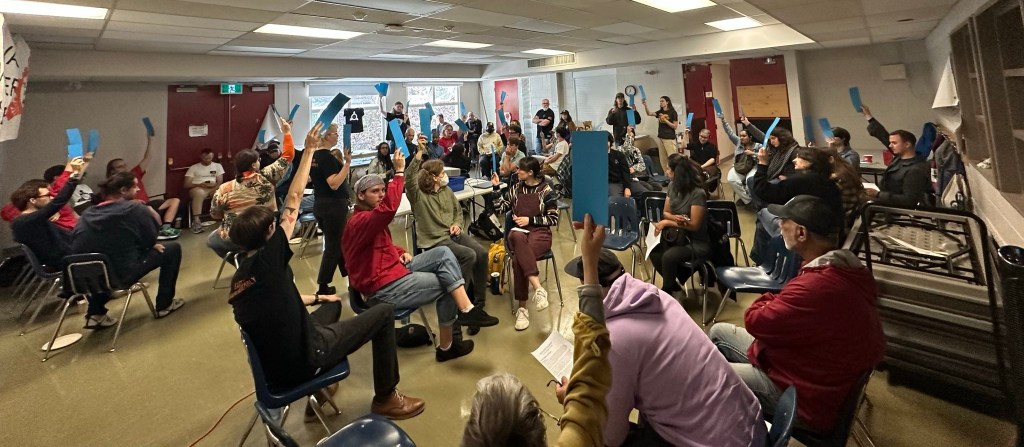
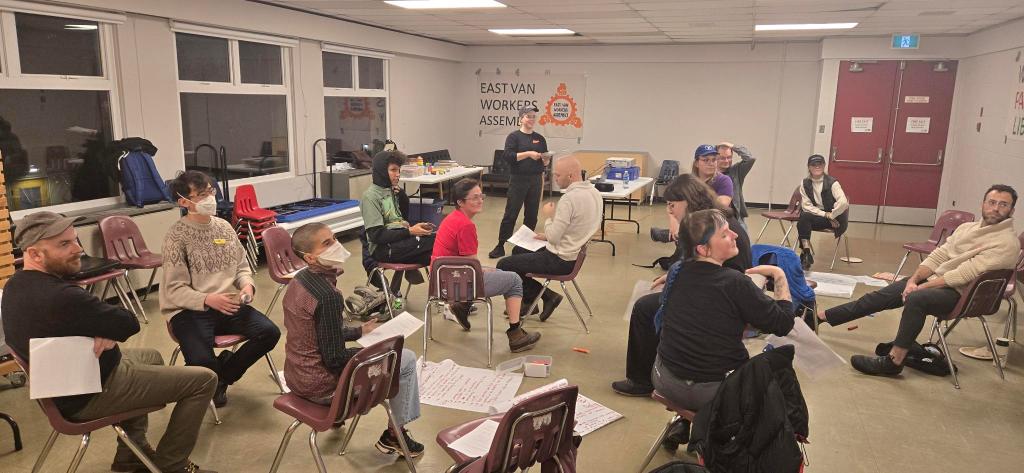
Over the past 6 months we have been tirelessly educating, organising, and preparing to mobilise for our campaign. Within the assembly we’ve had presentations and discussions around how workplace conditions and issues with injury manifest in different economic sectors. We’ve heard from construction workers, public sector workers, workers in warehousing and transportation, and throughout our assemblies, we’ve discussed how the struggle for better working conditions and safer workplaces is a fundamental issue, no matter what industry we work in. How, regardless of our job, our boss has an interest in squeezing us, pushing us to work harder and faster, in order to increase their profits.
We have also built new relationships, and strengthened existing relationships with the rest of the workers movement, in particular with unions. We’ve heard from union activists at our assemblies, presented at union meetings and events, and spoken with workers on the picket line about their working conditions. What we’re describing is a political intervention in the labour movement, presenting sharp class politics, and a more combative approach to advancing our interests. The idea was not just to create a paper coalition, what we’ve tried to do is struggle with and unite unions along the political line of our campaign and forge long lasting relationships.
Strengthening our relationships with the labour movement has been a significant success of Bosses Behind Bars, and is a product of the work of all of the members of the EVWA, whether it’s been building relationships with workers on the picket line, having organising conversations with our coworkers, conducting regular social investigation at workplaces across Vancouver, or bringing the politics of Bosses Behind Bars to our unions. Our efforts to involve ourselves in the day to day work of unions and the working class have made our assembly one of the most successful worker organisations in BC.
As we approach the Day of Mourning, we’re preparing to mobilise! We need everyone in the room to get involved and become a vocal member of the EVWA, and to help us move our base on April 27th. This can look like;
- inviting co-workers, friends, and family
- putting up posters and distributing flyers
- promoting the event in your union
- getting your local to sign on
This is a fight for not just one worker, not just one sector, not just one union, but the whole working class.



 United in Struggle
Leave a comment