
Defend our Homes, Defend our Neighbourhood
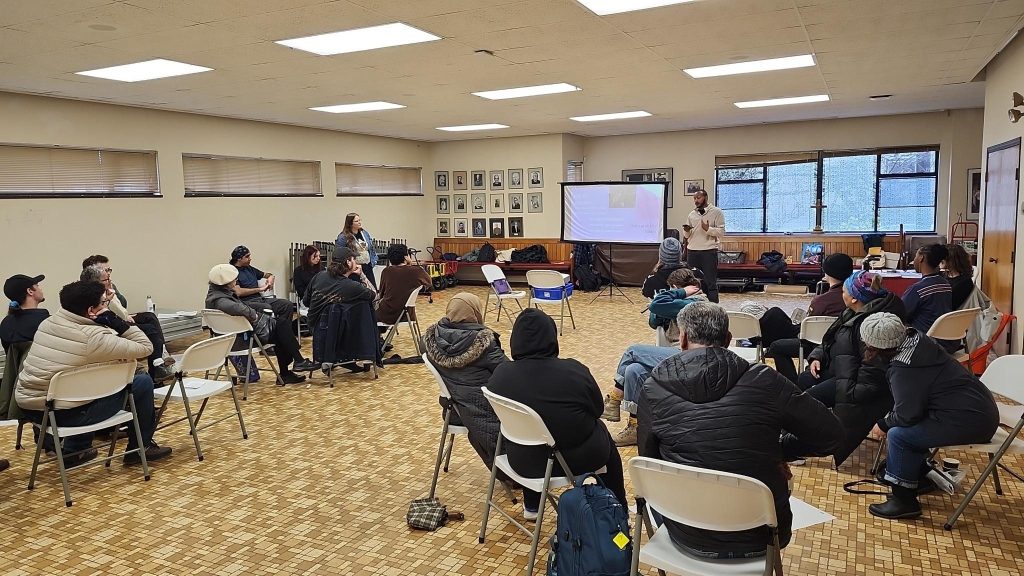
In the spring of 2025, the South Vancouver Neighbourhood Assembly (SVNA) began its first campaign, fighting for two affordable buildings in the neighbourhood being sold by the same enemy (William Nemetz Ltd). Yet our fight is beyond individual buildings, it is a fight for the entire neighbourhood to stay affordable. We exercise our power when we fight together, building by building! A fight for one building is a fight for all of them.
Background and Objectives
Objectives of the campaign:
- Expose William Nemetz Limited and the unknown buyer(s) as just one of the many class enemies in the neighbourhood
- Engage our neighbours in the campaign, the majority from 8833 Montcalm and 8770 Granville street., by uniting us across our differences.
- Escalate to confront our enemies as the united fighting force of the South Van Neighbourhood Assembly
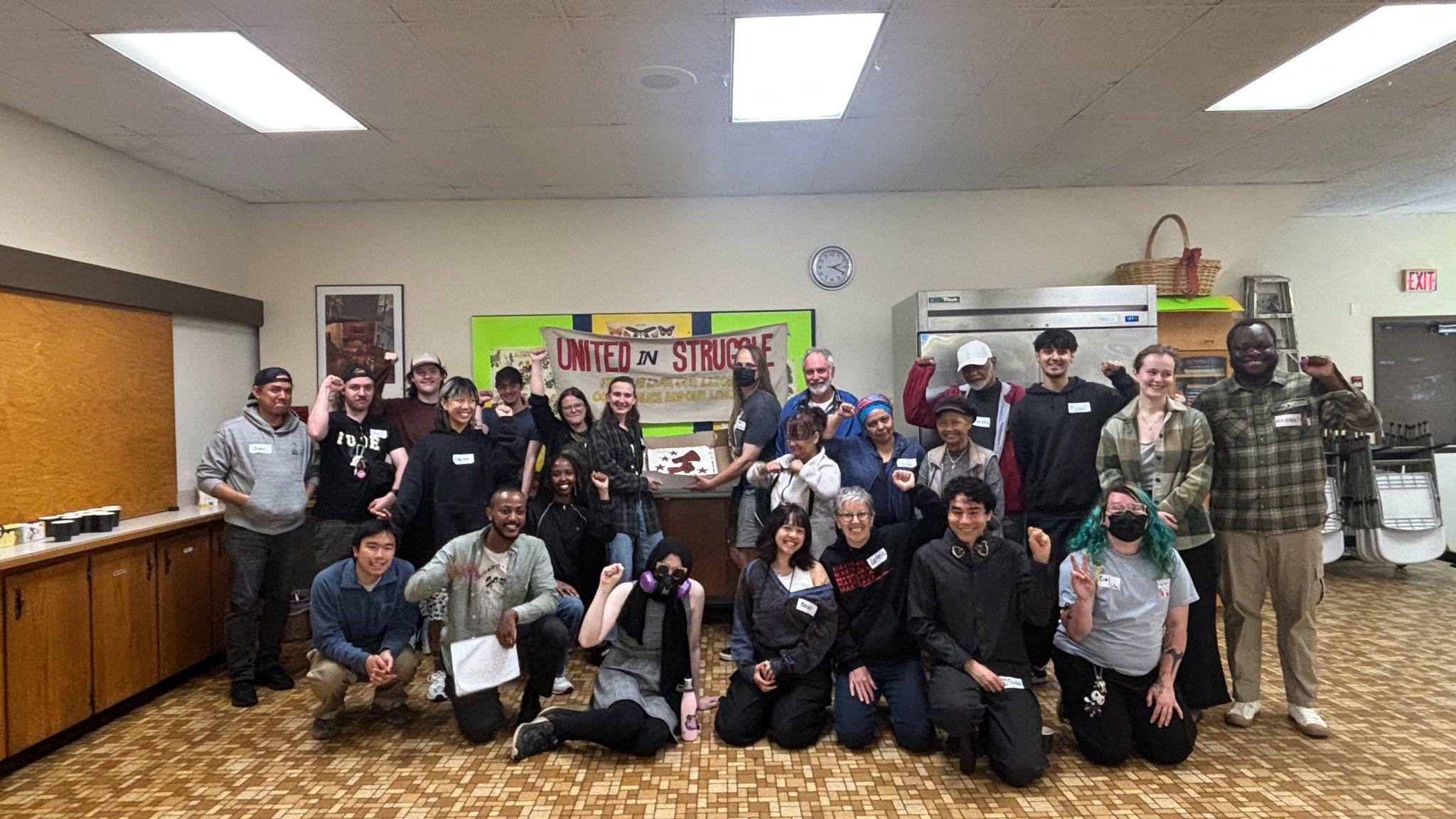
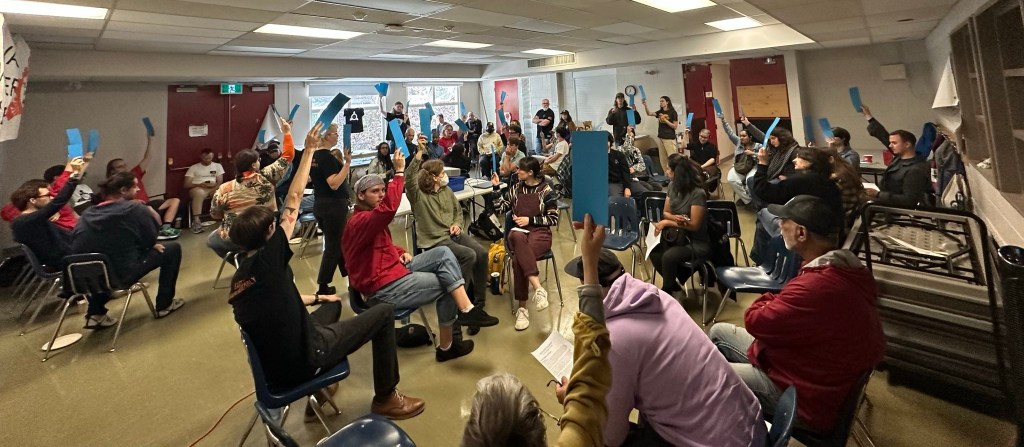
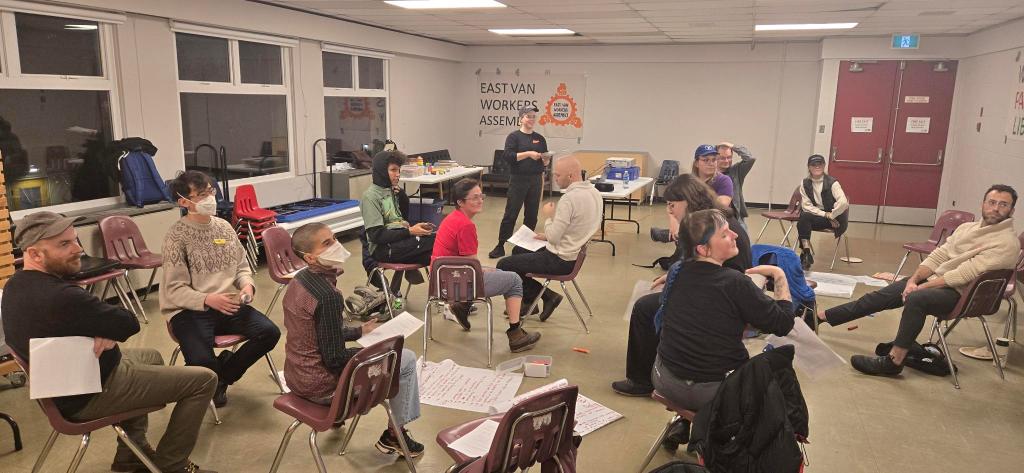
The South Vancouver Neighbourhood Assembly (SVNA) was launched in June 2024 in Marpole. In this working class neighbourhood, the threats of housing insecurity, unaffordable groceries, and inaccessible healthcare have never been more extreme. Founded in response to these worsening conditions and the need to struggle for the interests of the working class, SVNA is a democratic space for the community to unite, build working class power, and fight back against those who benefit from these crises.
Our assembly is united on four objectives:
- To establish and practice working class democracy.
- To continually develop and raise political class consciousness in our community.
- To overcome the differences dividing us and build unity towards a shared revolutionary vision.
- To struggle and fight back against those who benefit and uphold the crises we experience.
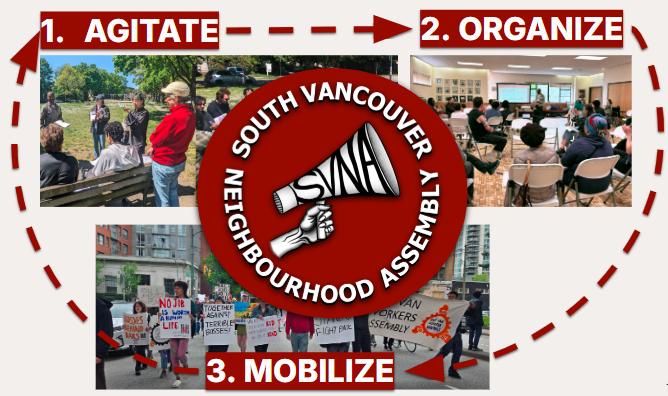
Leading up to the launch of the assembly, we completed a cycle of agitation and education with the goal of bringing neighbours in South Vancouver to the assembly. We mobilized our neighbours with the call: Our rents skyrocket & wages stagnate! The rich keep getting richer! Working class unity is how we fight back! The first year of assemblies worked towards the assembly objectives with a focus on educating and organizing members in attendance and working toward greater unity in the neighbourhood. Toward this end, we highlighted and continued to deepen our political lines on housing: the government’s plan for housing is the housing monopoly; the plan for the housing crisis is corporate profits.
We have been door knocking in South Vancouver for over a year now. Residents in the neighbourhood strongly resonated with the lines above – articulating clear financial insecurity and often pointing to corporate landlords and the government as the enemy. We heard questions about if it was possible to change anything. History shows us that nothing will change in favour of the working class unless we make it change, so our next step is to put this change in action. By specifically working closely with those already ready to fight, we can bring others along with us!
The next step of the SVNA is launching a campaign that brings our political perspective on the housing crisis to a specific fight against the enemy in Marpole. The campaign will advance the objectives of the SVNA: offer an avenue to practice and experiment in working class democracy, build unity and organizing capacity, raise class consciousness, connect to a revolutionary horizon, and push back against the encroaching development that is pricing our class out of the neighbourhood. We fight today so we can be stronger tomorrow.
Rationale for the Campaign
History of Marpole and Social Investigation
Marpole, a major industrial centre for the city of Vancouver, has been a bastion for our class. Covered in many residential units and low-rise apartments, this is a predominantly renting community housing generations of people who make this neighbourhood their own. These apartments are occupied by families, seniors, students, including a significant migrant population, all connected through their shared working class identity and struggles in the neighborhood. Neighbors work alongside each other at their jobs in furniture warehouses, the airport, and even on construction sites where development is happening. Despite being a mixed class neighbourhood, Marpole is connected through working-class struggle.
A resident of Marpole, mentioned to us that after all the displacement, demovictions, and renovictions; Marpole acts as the “Last Outpost” for the working class. However, as the ruling class seeks additional venues for capital accumulation, this community is positioned directly in the front of the firing line. Once again, facing the threat of displacement through the continuing onslaught of development, heightened by the anti-people Marpole Community Plan and entrenched by following legislation.
The Marpole Community Plan (MCP) has been gentrifying the neighbourhood under the guise of revitalization since it passed in 2014. The plan allows large developers and financialized landlords to speculate and profit, while residents face increased unaffordability, displacement, and worsening living conditions. For example, low-rise apartment buildings along arterial roads are rezoned to increased heights. The plan does not revitalize Marpole so much as it treats different parts of the neighbourhood as commodities to be speculated on.
The MCP’s strategy to “solve” the housing crisis mirrors previous failed “solutions” enacted by federal and provincial governments. Specifically, the MCP claims that the housing crisis is caused by supply and demand [pg 84, 8.2.3], but its proposed solution only facilitates corporate developers and financialized landlords to continue their attacks on working class housing with the enticement of low interest loans and changes in regulation. Previous iterations of this “solution” on the federal and municipal scale were failures, demonstrating that these loans and increased development do not solve the housing crisis.
For example, the Canadian government released its National Housing Strategy in 2017. This strategy entailed a 10+ year timeline with a budget of over =$115B. Its strategy is to fund developers with low interest loans. Over half ($65+ billion) of the budget went to loans, yet 8 years later, the housing crisis has only gotten worse.
Both the government and capitalist institutions spread the same false explanations for the housing crisis, purporting that: “The housing crisis is a result of a lack of units”, “we have a low rate of mortgages,” or “immigrants are taking up too much room,” among other anti-people ideas. These false claims are responded to with false solutions like development. Yet buildings continue to go up at unlivable prices, or the land is held onto for future profits in years and even decades later they are not lived in and sit empty.
These state-sanctioned plans that fund loans to developers gentrify our neighbourhoods, displacing us and putting corporate interests ahead of people. The ruling class and government’s priority is not to ensure everyone’s access to safe and affordable housing, instead, it is to maximize corporate profits and create a housing monopoly.
Our investigations have highlighted the true nature of the MCP, especially regarding its push towards increased unaffordability and worsening living conditions in the neighbourhood. We have uncovered several buildings that have become targets for speculation. One example is 8725 Oak Street, a building with 29 units. On December 15, 2023, the building was sold to Brandon James Harding, who specifically created the company 8725 Oak Street Holding LTD. to hold onto the building. Since its sale 1.5 years ago, it has remained empty and no construction has been made. It continues to remain empty as corporate landlords gamble and plan on its development into a 6-story building, in accordance with the MCP. Meanwhile, inflation and maximum rent increases are forcing families which have lived in the neighbourhood for decades to move out to cities like Langley, Surrey, and even out of province. With increasing development in Marpole, these occurrences of emptied out apartments sitting idle for the ruling class to cash in on will also increase.
Despite the MCP claiming to benefit the public, the plan does not protect tenants who are displaced by corporate development. The MCP recognizes the rental and working class characteristics of Marpoles’ population, but makes haste in excusing the annoyance by delegating it back to the city and the Tenant Relocation Protection Policy (TRPP).
Financialization
At the top of the list of enemies destroying our neighbourhoods are the monopoly capitalists composed of financialized landlords, public and private asset management companies, developers and the big six banks that finance them. Through competition, this section of the ruling class buys-out smaller capitalists in the neighbourhood, such as Willliam Nemetz Limited.. For example, in the 30 years since the legalization of Real Estate Investment Trusts (REITs), financialized landlords now own nearly 20% to 30% of Canada’s apartment rentals. In Vancouver alone, financialized landlords accounted for 25% of all apartments purchased in the local market between 1999 and 2021. Numerous examples demonstrate the negative impact these owners have on tenants. For instance, the average rent triples after a financialized landlord purchases a property. Through speculation, these landlords take long-term bets on our homes, evict us from our neighbourhoods and make huge sums of money in the process.
These monopoly capitalists are leading large-scale construction in South Vancouver. Large developers like Onni, Westbank, Intracorp, and Peterson divide up the neighbourhood, aided by state subsidies and financial schemes. These state subsidies are particularly lucrative for maintaining the profits of the ruling class when demand for their luxury homes decreases. For instance, Westbank has received over $426M in government-funded Canadian Mortgage and Housing Corporation (CMHC) financing to build its properties. These loans protect the interests of the ruling class and take away from our class. Additionally, when these developers can no longer effectively build and sell their condos, they turn into more stable forms of extortion — landlordism. It is not enough for the large developers to build the buildings; consolidation means they absorb other aspects of the business, including investing in managing rentals.
While these financialized landlords and developers may seem to operate independently of one another, the domination of the financial market by the top six banks ties them together. These publicly traded financial institutions possess significant holdings in one another, creating a functional monopoly. These monopoly capitalists control 93% of all bank assets in Canada and provide the capital for the large developers and landlords. For example, Interrent REIT became heavily invested in Vancouver in 2021 by borrowing $190M from these banks. This financing led Interrent to obtain five new buildings in Marpole. They now have a total of 16 in Vancouver with no plans of slowing down. Thus, as new buildings come up for sale, it is the financial capitalists who are best positioned to purchase, speculate and make profits on our homes. We must keep in mind the larger enemy consolidating its control over our neighbourhood as we struggle against the various capitalists.
Our fight
Our investigation has revealed a sharp contradiction arising from two buildings, 8770 Granville and 8833 Montcalm, being sold by William Nemetz Investments LTD, which were put up for sale in January of 2025 — the owners announced the sale in a New Year’s greeting card sent to all the tenants. The sale is projected to be finalized in September 2025. Existing tensions in the buildings have been bubbling for a while. At the end of 2024, some of the tenants had come together to write a demand letter targeting the property manager for their rude behaviour, which resulted in installing a new manager. The duration of tenancies in the buildings varies; a large portion has been there for several years, while others for several decades. As such, the rents are well below market rates. For this reason, a majority of the tenants do not want to leave, and many are worried about the sale because they will not be able to afford current asking rents.
Like many other buildings in the neighbourhood, the MCP allows for rental apartments up to 6-storeys at 8770 Granville (currently three stories). This means that developers encroaching on the neighbourhood will be aiming for mass reno-victions (i.e., the eviction of all tenants for the renovation of a building) in the name of bigger buildings and larger profits. Additionally, the loophole-riddled (Tenant Relocation and Protection Policy (TRPP) offers little to no protection for the majority of tenants. Fighting against this sale and future displacement has the potential to unite our base against the monopoly capitalists (the likely buyers) and mobilize the people to defend their neighborhood. This fight is only the beginning, but it allows us to politicize the issue of speculation and draw a line between the capitalists and the working class. It can clarify non-antagonistic contradictions and shift the blame onto the correct enemy, the ruling class, who gamble on our homes while we are forced out of our neighbourhoods. Finally, it provides us with an opportunity to articulate a long-term vision that presents our class line — our neighbourhood, under our control, through working-class democracy.
Our Campaign Call: Big landlords cash in on investments while we lose our homes!
Sub-calls:
Our neighbourhoods are for us to live in!
Building by building, we will fight for them all!
Targets
- William Nemetz LTD (and Nemetz & Associates LTD):
William Nemetz LTD is a business in Vancouver which owned 8770 Granville street and 8833 Montcalm street. The business is a subsidiary of Nemetz (S/A) & Associates Ltd, a multigenerational family-owned electrical engineering consulting business. This firm began as an electrical contracting company in 1961 and its annual revenue is estimated at $10.2 million. Nemetz (S/A) & Associates Ltd.’s locations in Vancouver, Calgary and Toronto and existing projects across Canada, the US and Asia demonstrate what imperialism does best: make money grow faster by expanding its reach, including globally. The firm specializes in contracts for electrical, communications and security systems, mechanical, plumbing and lighting design in mixed-use buildings and other components of our neighborhoods, including grocery stores, schools and community centres.
One tenant from 8770 Granville street, an airport worker, described his building’s sale as being against the working class’ interests. From looking at their clients, it’s clear that Nemetz (S/A) & Associates Ltd actively caters to the wealthy. The firm led the electrical engineering for two transit hubs: Marine Gateway for PCI Development Corp and Brentwood Town Centre, each designed to attract those with more money to the areas. Nemetz (S/A) & Associates Ltd also worked on the Hotel Georgia for renovations in 2011, leading to 156 luxury suites. Bosa is one of Nemetz’ clients, for a 37 story tower at 838 Hastings Street, as is Concord Pacific, a partnership which resulted in 61 luxury suites. The average salary for technicians, those who implement the electrical and mechanical systems, at Nemetz (S/A) & Associates Ltd is $22.64/hour. So not only is this target displacing the working class in our neighbourhoods, but it is exploiting our labour to do it.
William Nemetz himself is deceased; the current CEO of Nemetz Limited is his grandson, Steven Nemetz. Steven Nemetz ran for Park Board commissioner in 2018, an example of the ruling class’ direct role and interest in being in the current electoral system. Steven’s sister Franci assists with the firm. William’s oldest brother Charlie fled Russia to avoid pressure to become “a socialist and revolutionary”. The Nemetz family has been recommended by organizations, including the Jewish Federation of Greater Vancouver, to have a street named after them in Vancouver. The Jewish Federation of Greater Vancouver advocates for the right for Israel to exist and defend itself and states that Zionism can be an integral part of Jewish peoples’ identities.
- Unnamed buyer(s)
It is only monopoly capitalists and financialized landlords who have the $12 700 000 needed to buy 8770 Granville street and the $9 200 000 for 8833 Montcalm street.
Goodman Commercial Inc. is a top Vancouver-based commercial real estate company specializing in multi-family apartment sales, including both of the Nemetz buildings. Goodman allows big landlords to speculate at a quicker pace and higher intensity – reaping massive profits into the hands of the ruling class. As its website describes:
Goodman has brokered huge real-estate transactions in Metro Vancouver generating over $7 billion in over 2000 transactions in the past 45 years. The company leverages insights and market data to benefit their clients through the flagship Goodman Report.
- The state
Capitalists such as Nemetz (S/A) & Associates Ltd and financialized landlords such as the unnamed buyer(s) of the Nemetz buildings are upheld by the state; this intertwined relationship materializes through municipal, provincial and federal government policies.
The Marpole Community Plan was approved by the Vancouver City Council in 2014 under Mayor Gregor Robertson (Vision Vancouver). Robertson won the federal election for the Liberal Party in the Fraserview-South Burnaby riding, and was recently promoted to the Federal Housing Ministry top job, hence remaining an active enemy. However, the current mayor, Ken Sim, will be a main target. It is Ken Sim and Vancouver City Council who are amending the Marpole Community Plan which can make a major impact on the amount of development and displacement that will occur. With the MCP, corporate landlords are more incentivized to buy buildings which can be built taller: more units mean more profits.
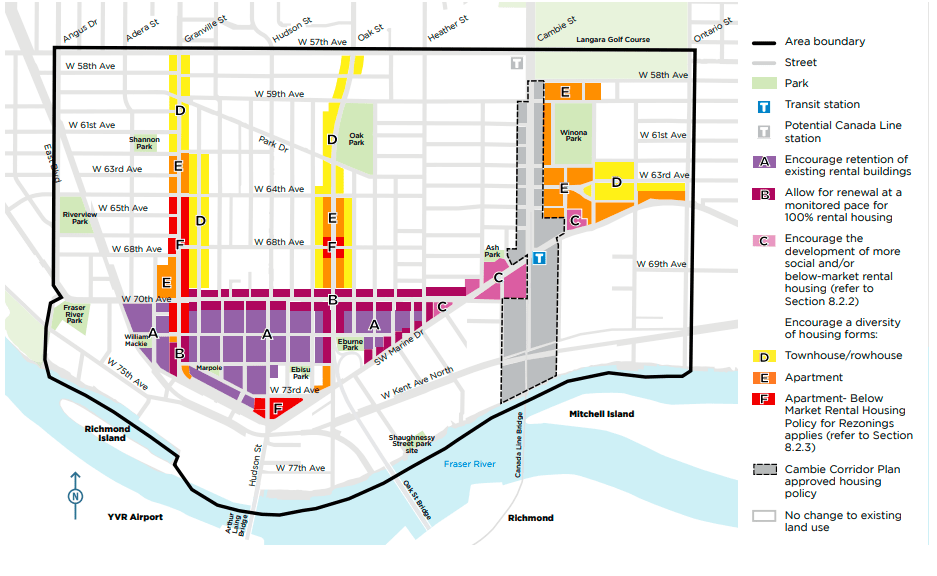
8833 Montcalm Street falls into the purple (‘A’) zone. Encouraging the retention of existing rental buildings might sound good but it really offers no concrete policy to make this ever happen. Financialized landlords want to profit more so they will continue to buy and sell buildings in the neighbourhood, pushing the working class to the margins. 8770 Granville is in the red (‘B’ zone). This means there is no requirement to build below market rentals.
So if the Marpole Community Plan’s zoning isn’t protecting working class housing and neighbourhoods, is anything? The Tenant Relocation and Protection Policy (TRPP) which came into effect in 2015 under Gregor Robertson, was first amended in 2019 under Kennedy Stewart and is currently being amended again under Ken Sim certainly isn’t. This policy allows some displaced tenants to move back into the new building, paying 20% less than the vague term “average starting rents”. This “discount” is nowhere remotely enough, especially considering the price of market rentals in 2025. Many of the tenants in the Nemetz buildings have lived there for upwards of 10 and 20 years, so they are paying much less rent than anything one would find these days due to the increasing pace of the enemy’s development. The TRPP offers other crumbs, such as varying months of rental compensation for the displaced tenants and “supports” for low income tenants to find below market housing. It additionally only applies to you if you’ve lived in the building for a year before the development permit was applied for. The VTU is fighting for changes to the TRPP. While the TRPP contains Enhanced Protections for buildings within 800 metres of a Skytrain station, such as Marine Drive Station, these protections don’t apply to either of the Nemetz buildings.
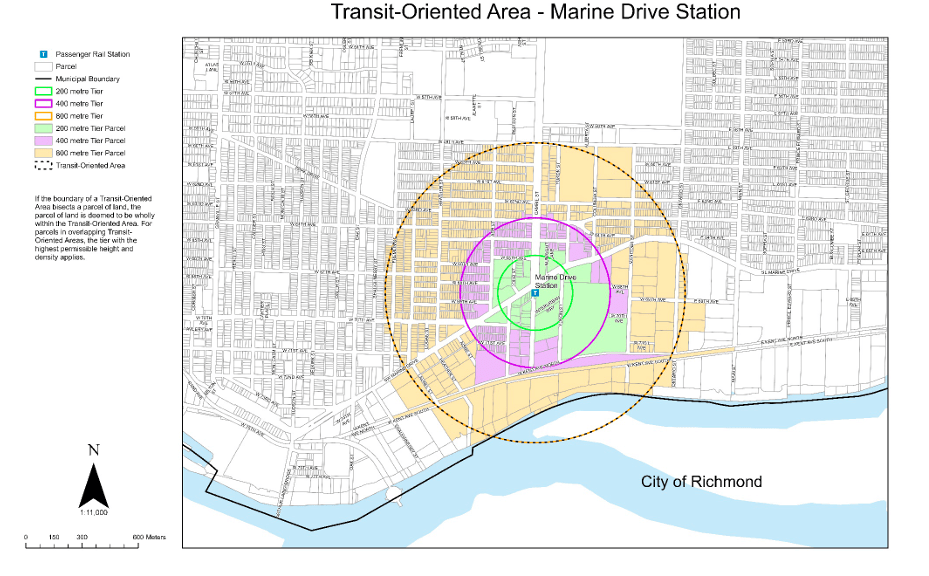
The BC-wide Residential Tenancy Act (RTA) does apply to the Nemetz buildings, but offers the tenants facing imminent displacement (or increased rent) next to nothing. Under the RTA, tenants who are displaced due to development have the “right to return” (but at the new rent), one month’s rent compensation, 30 days to dispute at the Residential Tenancy Board (RTB) and 4 months notice. Since 2011, landlords (including developers) have to apply to the RTB for permission to evict tenants for renovations, but given how much the RTB overwhelmingly favours landlords!), this is not protecting us from being evicted. David Eby is currently the premier of BC and he, alongside Housing Minister, the newly appointed Christine Boyle have no real real agenda to change this so-called “protection” into the right to stay in one’s neighbourhood, as pawns of a government backing monopoly capitalists.
A tenant from 8833 Montcalm St. told us recently that she believed there was a law which mandates that new owners of buildings have to keep the tenants, but sadly, this doesn’t exist. We need to organize now. No matter the plans and policies in place, the state’s collusion and integration with the ruling class means that any policy which does not serve their interests can easily be bypassed or ignored. This flexibility of the state routinely ensures that even activists pushing for tenant rights and protections are disappointed time and time again in the absence of a sustained and growing working class movement. Our long term fight for neighbourhood power is the only thing which will get us to a neighbourhood where this is a reality.
Base of Support
The average asking price for a rental unit in Vancouver is $2,800. Meanwhile, the average rental cost for a unit in Marpole is $1,500, making it one of the relatively more affordable neighbourhoods in Vancouver. Yet, South Vancouver has seen more and more development cropping up from Oakridge to Marine Drive. Marpole stands at the frontline of these changes with a particularly high percentage of older low-rise apartments, which building developers see as easier to buy up and demolish with new, unaffordable buildings coming in as replacements. Single family homes are also under attack through zoning within the MCP and the Province’s Bill 46. Members of our class who have bought property (and might be renting it out) are not the enemy – it’s the financialized landlords, corporate developers and monopoly capitalists.
At 8770 Granville and 8833 Montcalm, the two buildings for sale by William Nemetz LTD, the tenants are particularly agitated and uncertain about their future. Through our campaign, we will seek to organize and mobilize the tenants in these two buildings to build their power to fight for affordable and secure tenancies. We also know that this campaign can only be fought alongside a community of neighbours that are ready to fight and who can strengthen our demands with numbers and organizing capacity. We know that the sharper the understanding of the housing crisis, the better we can connect what happens in one building to the larger struggle against the corporate monopolies. Developing a collective understanding of this crisis and building working class unity, as we have done in the SVNA, will continue to be key in drawing in neighbours to this fight.
Additionally, we will use this campaign to build connections with like-minded organizers who find themselves engaged in similar fights throughout the city. Activists with experience organizing housing defense campaigns throughout the city, can join ranks. Likewise, connections can be made between unions that are running campaigns that address housing and the cost-of-living crisis. BCGEU’s AffordableBC campaign offers a clear assessment of the housing crisis driven by speculator impunity. In spring 2025, Unite Here Local 40 organized a rally with the call, ‘Put Housing Before Hotels!’ opposing municipal policy that encouraged billionaire hotel development. Connecting with unions involved in current housing campaigns is a way to draw a clear connection between workplace and neighbourhood struggles and advance our commitment to working class unity.
Our Demands
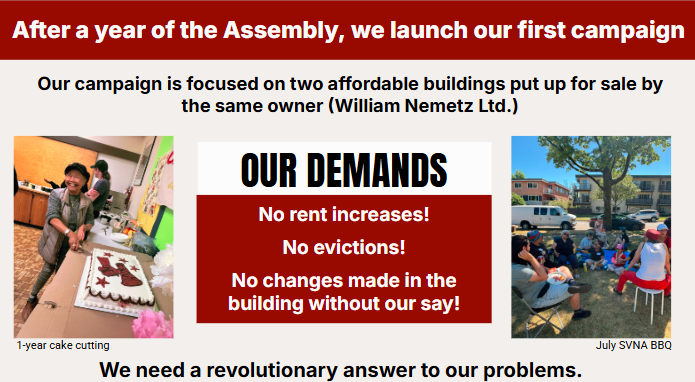
- No rent increases!
Landlords can apply to the Residential Tenancy Board (RTB) to increase the rent above the legislated yearly increase (3%), which in itself hurts. Our enemies justify rent increases by renovating, frequently resulting in changes that aren’t actually helpful or anything which tenants have asked to be done. For example, a tenant in the neighborhood told us he pays more rent because his stove was fixed but it doesn’t actually work any better.
- No evictions!
Displacing tenants is one way in which financialized landlords maximize their profits, as new tenancies mean landlords can increase the rent to whatever they want it to be. The win of vacancy control from the struggle of tenants in the 1970s was rolled back by an organized landlord lobby. This concession didn’t last for more than 2 years; decades later we exist in a cycle of evictions at the mercy of our enemies using what should be a human need for massive profit.
- No changes without collective consultation
Although we pay to live in our buildings, we have no say on what happens, including when and how we are forced out. Through our investigation and conversations in the neighbourhood, we’ve met tenants who experience this in many different ways. Tenants from various buildings in Marpole have been told they have to pay more for laundry, have to live without a buzzer system for an interim period, can’t have pets any longer and have to deal with new ownership. All of these decisions from building ownership should have had meaningful consultations.
Timeline
Flashpoints are objective moments which we can mobilize around.
The amount of time it takes for a building to be sold and go through related permits varies. A film worker from 8770 Granville took comfort in the fact that the building across the street has been on the market for a year. But as we explained to her, we can not rest easy and hope for the best. We need to organize now, so we are ready for when this bureaucracy works its way through City Hall’s bloody pipelines.
A home is normally on the market for 56 days in Vancouver, but we can not assume the same for apartment buildings. Once a building is sold, it takes a developer a year to obtain a permit to begin a development. A developer has to submit a development permit application, pay a fee and wait. The Director of Planning or the Development Permit Board may seek advice from a variety of committees, none of which serve the working class. There might be a public consultation. After this, the developer has to submit a building permit, which must be approved. The developer also must get permits for all the construction which happens, including plumbing and electrical.
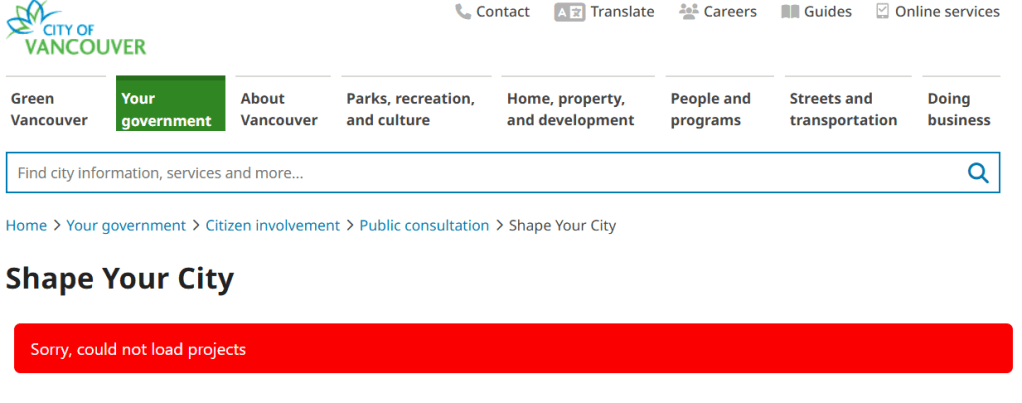
A call to the City for more information on this timeline (particularly about how long it all takes) directed us to a dead end web page.
Although the City’s development application process is currently being streamlined from 1800 pages to 100, this remains an exorbitant amount of bureaucratic bullshit to sort through. One shouldn’t need a degree in Planning and Policy to understand how our neighbourhoods are being planned by those who “represent us”. This is another tactic of the enemy: to confuse us. The state is fast tracking corporate profit and green lighting assaults from financialized landlords and we can’t even clearly see how this happens. We can not wait to act until development permits are approved to begin fighting. We must raise class consciousness now, realize the power we have, and take up an offensive that will prepare us better for the future. We fight one enemy, we fight them all!
Take action
- Come out to the SVNA for updates on the campaign
- Become a SVNA member and participate in our upcoming mobilizations
- Invite your neighbours to the SVNA
- Join members of the SVNA for regular door-knocking sessions at buildings being hunted down by enemies in the neighbourhood
- Talk to your union about supporting the SVNA


 United in Struggle
Leave a comment