
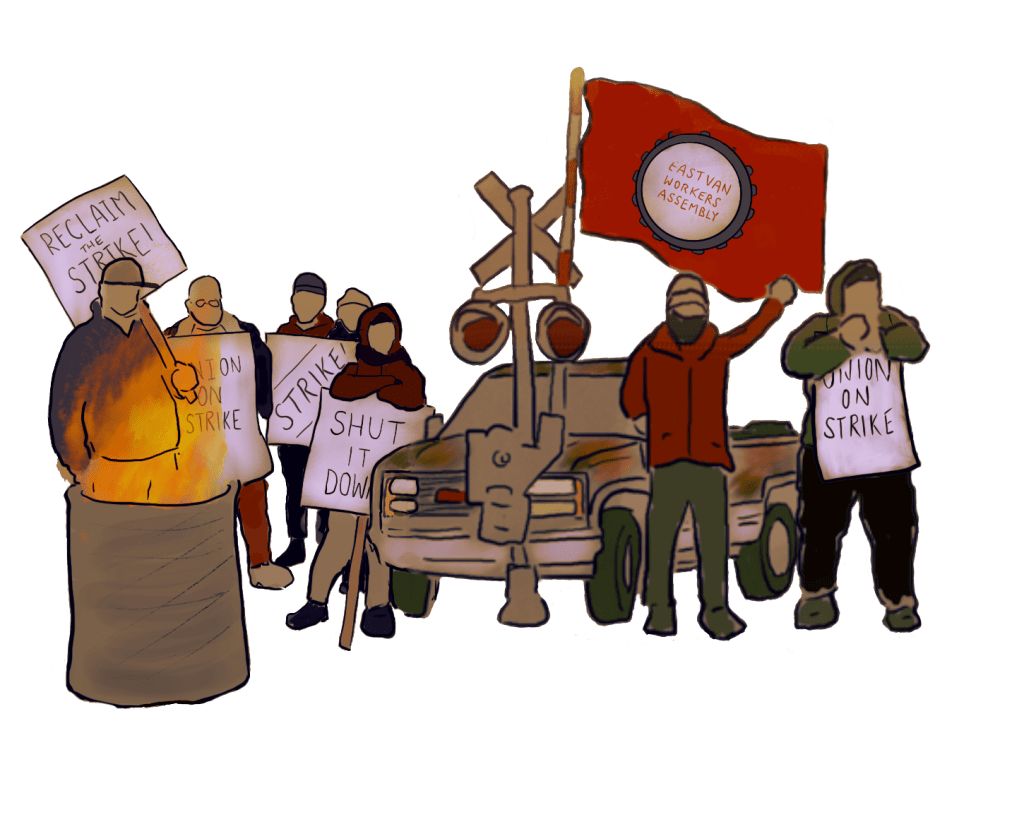
STRIKE BACK!
Even under unionized conditions, the balance of power between capitalists and workers is heavily weighted in the bosses’ favour. Capitalist power flows from the ruling class’s ownership of property, immense wealth, and organized control of the government and Canadian state. The legal protections and processes we do enjoy – rights our class achieved through decades of struggle – have improved living conditions for millions of workers, but at the expense of constraining our organizing and militancy today. In order to even defend these existing achievements from being squashed by the ruling class, new waves of struggle are necessary. No rights, benefits, or workplace protections are safe if the bosses can simply impose their will on us. Whatever issue workers face or demand they have of the bosses, big or small, it is collective struggle and confrontation – not backroom begging – that will get us what we need. Working class economic and political power must be won by directly confronting the capitalist class, and can only be conquered by united workers organizing and striking to shut down the employer’s flow of profits.
Rationale:
The working class in this country is in dire straits. Everywhere you turn, people are feeling the squeeze: runaway inflation, unaffordable housing, low wages, gutted public services, union-busting, and worker repression. Labour unions are the most fundamental organizations workers have to defend and advance our interests, but the state of the movement is weak and our highest leaders are afraid to rock the boat, even when they know we’re getting screwed. Our greatest weapon is the strike, but until workers are organized and combative enough to strike against the status quo of dictatorial employers, repressive labour laws, and government interference, we will never exercise the full power of our unions – in our workplaces or in our communities. When workers unite to withhold our labour and shut down business as usual, that’s when we can shift the balance of power.
Despite a 2015 decision by the Supreme Court affirming in principle the constitutional right to strike, in practice Canada’s labour relations system is actually incredibly restrictive and bureaucratic. The right to strike in particular is very narrowly defined, applying only to unionized workers, outside the life of a collective agreement, after all other efforts at “good faith” collective bargaining have been exhausted, and doesn’t even protect the use of tactics like hard pickets. And even under these circumstances, employers routinely use private security and police, jam unions up with frivolous lawsuits, and collude with politicians and government agencies to attack unions and crush their ability to carry out strike actions. The recent wave of back-to-work orders issued using Canada Labour Code, s. 107 is unique only in how flagrant the level of collusion was between the federal government and the monopoly corporations Trudeau, Carney, and co. bent over backwards to protect. Even the dying NDP showed recently their true colours here when interim leader Don Davies told a crowd of angry flight attendants at Vancouver International Airport, without a hint of irony, that the Liberals should have broken their strike “the right way,” by passing “democratic” back-to-work legislation through the House of Commons. These incidents underline the fundamental class conflict in Canadian society, demonstrating that the ruling class views the workers’ strike as a potential threat to be tolerated only so long as it doesn’t seriously compromise their power and profits.
The present labour relations system has its roots in a series of post-World War II reforms and concessions that together established an overarching “compromise” between the industrial capitalist class and the union movement. Particularly important was the Rand Formula, the key principle in the 1946 arbitration decision that ended a major strike at the Windsor Ford plant. In exchange for a guaranteed dues checkoff system that ensured union dues would be automatically deducted from workers’ wages, all strike action outside the narrow confines of collective bargaining was banned and made subject to severe fines or even imprisonment. The Rand Formula, which is still in effect today, helped stabilize the unions and labour-management system of the postwar era, but at the expense of sacrificing the movement’s fundamental lever of power. Instead of collective struggles on the shopfloor in response to issues as they arose, workers were forced to seek remedy through much weaker, individualized legal procedures taking months or even years to resolve. This is sometimes referred to as the “work now, grieve later” system. It also meant that later on in the 1970s and ‘80s when the ruling class accelerated their attacks on organized labour, the unions were in a much weaker position to fight back. What the unions knew early on and are now being forced to learn all over again is that the organized ability to strike is the best measure of the workers’ movement’s strength and the overall balance of class forces.
Whether the highest leadership of the CLC and the NDP like it or not, the emergence of s. 107 as a weapon to suppress strike activity has unintentionally resurrected the strike as maybe the decisive question in the Canadian labour movement. CUPE’s initial defiance of the Liberal government in the recent Air Canada strike, however short-lived, has catalyzed union forces across the country and drawn clear battle lines between the vast majority in the working class and our shared class enemy. It is highly unlikely the CLC would have taken the extraordinary steps that it did, calling for the total repeal of s. 107, if broad sections of the workers’ movement hadn’t rallied behind CUPE the way they did. This is not a fight CLC brass actually wants to lead, but the one thing they’re truly afraid of is losing their grip on the labour movement. So while this sea change presents a major opportunity to further advance the strike issue beyond s. 107 or narrow legal questions, there is also a danger of this energy being tamped down or redirected away from militant confrontation by reformist leadership. The labour relations status quo doesn’t work for the vast majority of workers, but it does for politicians and high-level union bureaucrats whose job it is to manage the level of struggle and keep it within acceptable parameters.
One of the reasons the Strike Back campaign is so important is that the popular backlash against s. 107 can only go one of two ways: towards fully reclaiming the strike as our most important tool for building worker power, or opportunistic capture by an NDP that only wants to waste our time and resources rebuilding its own reputation.
Our Calls:
Straightforward demands to the ruling class and the government, including for the legal recognition of our right to strike, are most likely to fall on deaf ears. Even worse, they could put us in the position of trying to negotiate with the enemy, hopelessly trying to convince the monopoly capitalist class to voluntarily abandon one of the cornerstones of their class rule. If we want our rights strengthened and demands met, we have to back up our words with action. Only striking force – the collective power and fighting spirit of the working class – is going to change the balance of power. That’s why EVWA is calling for the workers’ movement to take up the following objectives:
- Organize in the unions for a militant strike policy and a fighting stance.
Striking is not a measure of last resort. It is the primary weapon of the organized working class. We must be trained and ready to struggle against the bosses to both defend ourselves in the workplace and to advance our rights and interests. Rank-and-file workers need to take hold of their unions in order to make them real democratic vehicles that can unleash the power of the class. If the union embodies our collective power, then the strike is what makes it a weapon.
- Aggressively expand the union movement into unorganized sectors on a wave of direct struggle against the bosses.
Seventy percent of the Canadian economy is non-unionized. Although the labour movement has seen some minor growth in recent years, this trend remains small, fragmented, and relatively weak. Instead of seeding tiny bargaining units here and there, we need to build big, combative, rank-and-file-led unions with collective struggle in their toolboxes from day one. Train new union recruits to unite and fight to solve their problems, instead of just passing them off to an official and hoping for the best. If we fail to build muscular organizations, whatever gains these new unions make can and will be lost in a sea of legal red tape and backroom deals. If we want our unions to really mean something, workers can’t put their hopes in lawyers or the LRB to save the day. By organizing unions that are born fighting, and are ready and willing to take action – even strike – from the beginning, we not only grow our movement, but increase its unity and power.
- Build the unity of the workers’ movement. Raise individual workplace fights into collective struggles by organizing between unions and mobilizing workers to begin practicing solidarity strike actions.
The capitalists have class solidarity and they are organized: through government, law and the courts, think tanks, business cartels, and more. Every individual worker struggle contributes bit by bit to our movement, but until we can also achieve this kind of ironclad solidarity – across unions, employers, even industrial lines – our class’s strength will never grow to the level necessary to really strike back. For the workers’ movement to take the next step to encompass class-wide struggles, our fights need to grow beyond the boundaries of a single workplace or union. Canadian labour law prohibits actions like solidarity strikes precisely because they endanger the monopoly of power that large corporations can unleash against isolated unions and workplaces. Building fighting unions means that slowly but surely workers must build up the collective courage to defy laws like this, which exist only to keep us in check.
The working class movement needs to build our unity, our organizational strength, and our fighting spirit to overcome the ways the bosses not only separate us, but try to dictate when, how, or why we’re allowed to struggle. Organize, unionize, fight – STRIKE BACK!
Campaign Objectives:
The Strike Back campaign will be focused on deepening the unity, political consciousness, and fighting capacity of the working class by raising the strike – not only as a legal right – but in concrete terms as our movement’s primary and most powerful tool of class struggle. The calls of the campaign are directed primarily towards the unions, and in particular the advanced who want to build the fighting capacity of their unions and are frustrated by cowardly or absent leadership. By winning these elements to the campaign, working with them to establish committees of struggle in their workplaces and unions, and helping lead them into concrete class struggle, we can draw together these shopfloor fights with the broader propagandist struggle against the enemy. This level of the campaign will target the monopoly capitalist class and agitate against the legal and extralegal restrictions on workers’ ability (and willingness) to strike as expressions of ruling class power that must be overcome and defeated.
The broad objectives of this campaign are as follows:
- (Educate) Raise class consciousness of workers by presenting a clear political line directed at monopoly capitalists as our main enemy and the government/state as their political agents.
- Develop mass education and prop a) raising the strike as our primary tool for exercising worker power, b) attacking all forms of anti-strike legal repression (i.e. challenging the opportunist position that s. 107 is the only illegitimate restriction), and c) identifying the political strike, leveraging our class’s economic power through work stoppages, as our vision for how the workers’ movement can take the offensive against the bosses.
- (Organize) Consolidate members and supporters of EVWA by leading them to conduct basic political work through our Solidarity Worker Action Team (SWAT) among workers and unions: investigation, agitation, and mobilization.
- Broaden and deepen EVWA’s connections with the union movement. Lead key union locals, leaders, militants to take up campaign demands, educate/agitate for rank-and-file strike readiness in their unions, begin organizing rank-and-file struggle committees that can eventually transition into functional strike committees, etc.
- Expand the active membership of EVWA, particularly amongst active unionized workers, supporting a) the establishment of the Public Sector Caucus (PSC), b) laying groundwork for the Logistics & Transportation Caucus in 2026, c) workplace organizing initiatives, and d) EVWA’s affiliation to Workers’ Alliance as a Canada-wide political workers’ organization.
- (Mobilize) Provide political leadership through EVWA-led struggle committees to mobilize workers into direct class struggle around concrete objectives. (Should favourable objective conditions arise, this could escalate to leading striking workers through actions including: training rank-and-file leaders, providing political/organizational support for strike committees, launching solidarity picket actions, mobilizing external union forces, etc.)
- Unite politically advanced and combative forces in the regional workers’ movement to participate in a Strike Back Conference with the aim of consolidating them under our leadership around a platform of organizing struggle committees, striking to win all future contracts, solidarity organizing for other striking unions, formal opposition to restrictions on the right to strike, and building capacity to defy such restrictions, up to and including the political strike.
These political objectives will not in themselves automatically lead to the revitalization of widespread, militant strike activity. Instead, they reflect the understanding that campaigns are stepping stones that allow us to approach our longer term strategic interests by speaking directly and forcefully to the felt needs and concerns of angry and class conscious workers. In order to achieve our broader goals, we must launch and fight campaigns like this that expand and deepen our political work amongst the broad masses of workers, and in particular within the union movement.
Please note: While the Canadian Labour Congress (CLC) has recently taken the significant step of calling for the repeal of Canada Labour Code, s. 107, the aim of ending legal restrictions on the “right to strike” as such – which the CLC motion still falls short of – is not the primary focus of this campaign. The fight against anti-strike laws is an important component, but should remain secondary to building the political strength to effectively and consistently wield the strike as a tool of class struggle.
Our Targets:
Monopoly Corporations:
The extremely high level of control that monopoly capitalists and large corporations exercise over production, distribution, and overall work processes stems from their economic power, ability to dictate wages and workplace conditions, and, when necessary, call in external repressive forces through the state, courts, and private security. Capitalist class power has only increased since the late 1970s, the last period of serious strike activity in Canada, while union density and the frequency/scope of strike actions in key industries (e.g. manufacture, logistics, resource extraction) have declined overall.
There is a growing trend of popular anger about unrestrained corporate power that this campaign can speak to directly. Monopoly corporations under federal jurisdiction that have recently colluded with or pressured the government to invoke s. 107 present particularly sharp examples of the ruling class’s coercive power. Corporations in this category tend to fall within the transportation and logistics sectors: Air Canada, Canada Post, CN and CPKC railways, and shipping cartels like the BC Maritime Employers’ Association. More broadly, any monopoly corporation that has demonstrably repressed their workers’ rights to unionize and collectively bargain (e.g. Amazon), or effectively carry out job action (e.g. Heidelberg Materials) should be directly targeted.
Government:
Not only have they failed to protect and support workers and unions, but government and state agencies at all levels have demonstrated open collusion with big business interests to weaken and crush legal strike actions. The federal Liberal government, under Trudeau and now Carney, has repeatedly invoked s. 107 to shut down picket lines and impose garbage contracts, helping businesses circumvent the need for genuine collective bargaining. Even last year when they held some degree of influence over Trudeau’s minority government, the federal NDP stood by and made only weak protests on the union movement’s behalf. The NDP is currently putting on a pro-worker posture after being decimated in the recent election, but their appetite for actual struggle is minimal. In pushing for the escalation of combative strike activity, we have a golden opportunity to expose their hollow rhetoric for what it is. The NDP’s overall orientation remains firmly on perpetuating the fiction of “labour peace,” which is just another term for shutting down direct worker-led struggles against the boss.
State Institutions:
State institutions like the Canada Industrial Relations Board (CIRB) and the courts can in some cases protect workers’ interests. But while they themselves are not the enemy, the governments and legal systems they correspond to are not neutral, and so the decisions and policies they make are more likely to benefit the capitalist class than workers. Even though the CIRB claims to be an independent body for adjudicating labour disputes, its leadership is appointed by the federal government and ultimately answers to those interests. The courts are also responsible for upholding a regime of legal law that primarily serves property rights, not workers’ rights. Institutions like these should be used by workers when it’s tactically advantageous, but their bureaucratic structures tend to repress militancy and weaken collective struggle down to individual petitioning. Ultimately, their purpose is to protect capitalist property rights.
Our Base and Allies:
This campaign seeks to unite workers who are angry about corporations being able to do whatever they like, consequence-free, and want to fight back and stand up to the bosses. In practice, the primary base most likely to respond to the calls of Strike Back is among already unionized workers frustrated by the limited responses of their unions and looking for more combative solutions. However, it can also speak to a smaller segment of non-union workers interested in or already attempting to organize their workplaces. These are workers who can be won over to embracing strike combativity, including the use of job action in the unionization process, as the only guarantee for building and maintaining a strong union.
The numerous federal back-to-work orders of the past year have created significant divisions within unions like CUPW, TCRC, and CUPE over how their respective national leaderships handled things and whether they should have done more to keep the picket lines up. Without getting too drawn into the political dynamics inside these unions, the anger and militancy of large segments of the rank-and-file can be harnessed and given direction by the campaign. Unionized workers in other sectors who were energized by CUPE’s brief defiance of the Air Canada back-to-work order and came out in solidarity of the flight attendants are also uniquely winnable to the campaign’s demands at the moment.
One of the strengths of organizing through political campaigns is that they allow us to reach a much broader working class audience than we would otherwise be able to through monthly EVWA meetings or SWAT actions. This accelerates the quantitative growth of EVWA’s footprint in the organized labour movement and amongst angry and class conscious workers. Increasing numbers strengthen EVWA’s visibility and popular legitimacy, which in turn gives us more opportunities to meet, learn from, and provide external solidarity to additional unions and workers. However, if this isn’t accompanied by qualitative growth – that is, by leading workers to take up class struggle politics and a fighting stance inside their own unions and workplaces – then EVWA’s capacity to effectively organize combative struggles will face hard limits. This is why, in conjunction with the sweeping political calls around the strike, the campaign can contribute to the investigation and basebuilding necessary for EVWA’s industrial caucus and workplace organizing. By building these up as internal interventions that can directly agitate and empower shopfloor workers to take their first steps struggling against the boss, EVWA and SWAT will also be in a position to grow and mature as external bodies by mobilizing solidarity and helping to raise the level of that struggle.
Campaign Timeline:
The preliminary campaign timeline is expected to be approximately 8-9 months in duration, from September 2025 to May or June 2026. However, due to the unpredictable natures of collective bargaining and union politics, this schedule may be subject to change if it becomes necessary to proactively react to acute class struggles as they arise.
| Educate (Sept – Dec) | Organize (Dec – March) | Mobilize (March – June) |
| Presentations to union locals (including pitches for donations and investigation of potential for direct engagement through Organize and Mobilize phases) Worker and SWAT Committees collaborate on campaign prop EVWA survey on bargaining, unionization, job action experiences Social media series on right to strike, significant strike victories (including “illegal” strikes), testimonials from workers about previous strike experiences Monthly EVWA education series on campaign with specific sectoral and/or thematic topics | Small flashpoint rally to mark one-year anniversary of CUPW s. 107 order (December 17) Develop and share template resolution for union locals, caucuses, etc. to support campaign calls Mass organizer training session for active SWAT, PSC, workplace organizing, union contacts | Strike Back Conference gathering supportive locals, struggle committees, orgs, other allies Circumstances permitting, lead internal and external forces to train, support, and escalate the struggle of friendly striking union(s) |
Take Action:
The success of Strike Back depends on EVWA’s members and our supporters in the union movement uniting around the campaign’s call and taking action to make it a living, breathing force around Greater Vancouver and beyond. Some ways that people can get involved include:
- Put up monthly EVWA and Strike Back campaign posters;
- Distribute campaign materials in your workplace;
- Invite EVWA to help host a union local- or shop-level discussion on the campaign issues;
- Bring the campaign to your local or other union body and get them to sign on and/or commit to participate in the Strike Back Conference;
- Take the EVWA survey on previous experiences of bargaining, unionization, and job action;
- Get involved with SWAT or the PSC;
- Participate in EVWA organizer training (by invitation);
- Participate in a campaign rally or solidarity action;
- Volunteer to help plan or run the Strike Back Conference;
- Join EVWA as a dues-paying member;
- Build a struggle committee in your workplace or union local.

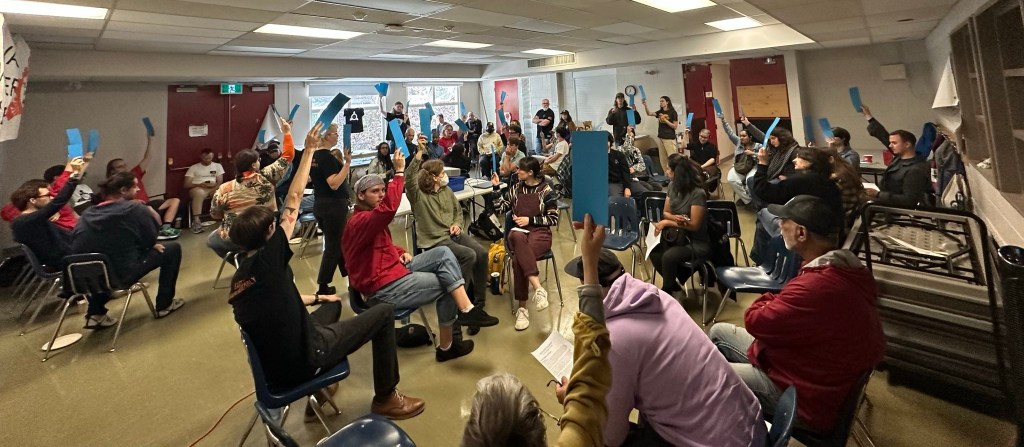
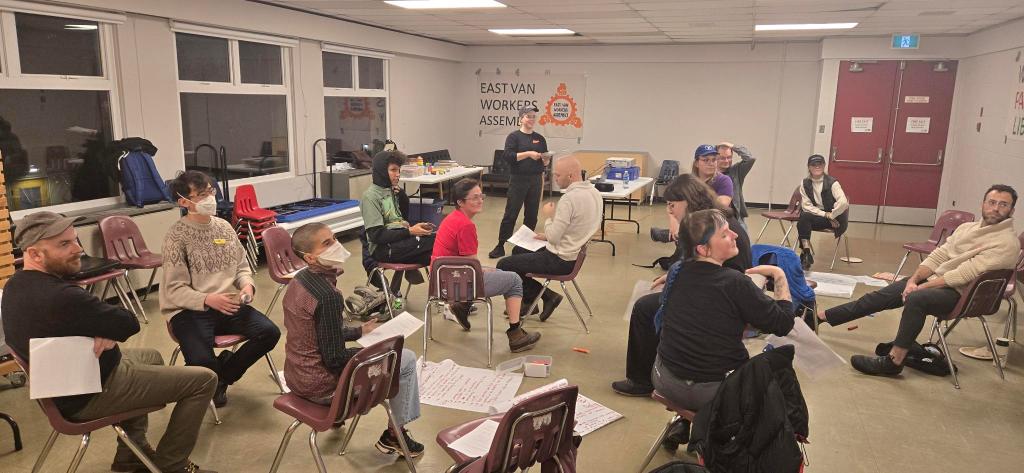
 United in Struggle
Leave a comment