
Vancouver’s Tenant Relocation and Protection Policy is a Tenant Pacification Policy
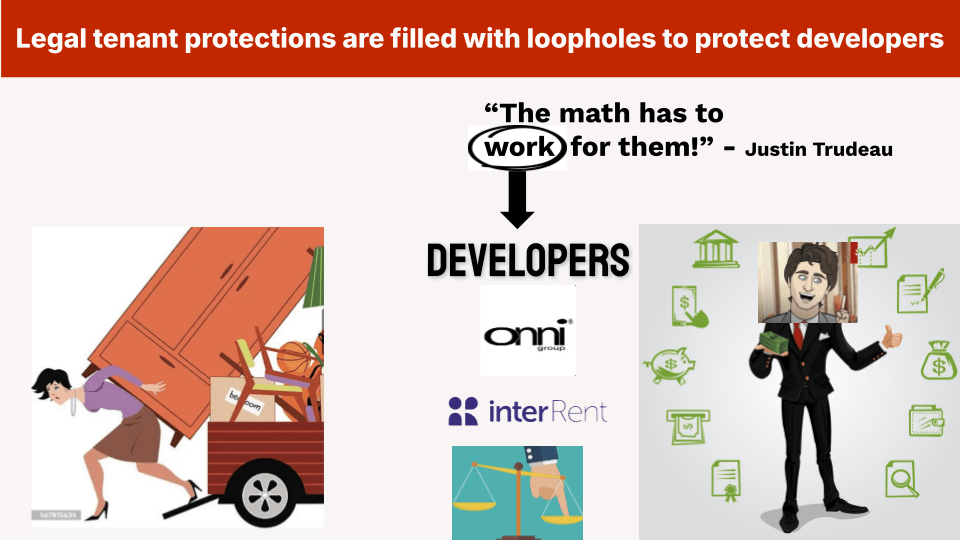
Governments always speak of tenants as deserving of rights that must be balanced with the needs of developers and landlords because “they are the ones who build and manage housing”. Our taxes therefore flow into their businesses instead of actually building affordable housing for us. As Trudeau famously said “the math has to work for them”.
Tenant legislation therefore is no longer working for us at all. Its latest iteration for Vancouverites is the Tenant Relocation and Protection Policy (TRPP). We more accurately describe it as “Tenant Pacification Policy” as it merely puts a veneer of fairness on pushing people out of the way of real-estate profiteering.
Tenant rights were initially won in the 70’s as the result of tenant struggle against landlords’ exorbitant rent increases.
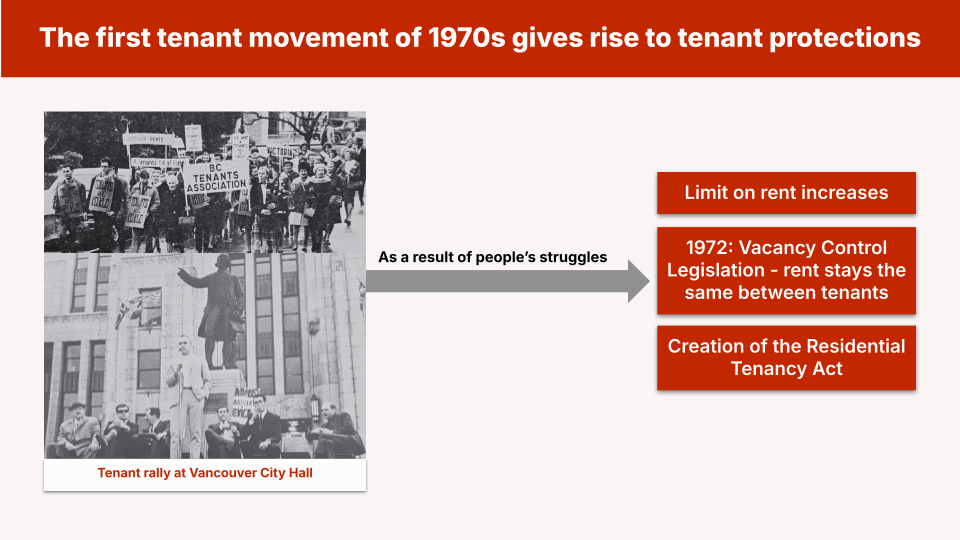
At its peak, the tenant movement of the 70’s won Vacancy Control, a significant protection which would guarantee rents stay the same even when new tenants move in. However this measure was lost in less than two years due to landlords’ lobbies.
The loss of Vacancy Control remains a huge win for the capitalist class to this day. Nevertheless, winning the once a year rent increase limited to inflation made a real difference at a time when housing costs were reasonably in step with wages for most people and affordable rentals could still be found when evicted.
With tenants winning these rights, big landlords seeing the loss of future profits in the rental business switched to the business of building and selling real-estate. An ideal opportunity was just going through legislation at that time: the 1979 Condominium Act. After Expo 86 brought world fame to our city, many new condo buyers rushed in. Meanwhile, affordable rentals became increasingly more rare.
Move forward twenty years. The displacement of people in the Downtown East Side and West End increased significantly due to demolitions in preparation for the Olympics. Mayor Larry Campbell promised that the Olympic Village was going to benefit us with over 4000 new social housing units, but this promise did not materialize. Instead the Olympic Village was sold as luxury condominiums with only 252 units of social housing.
During this time, the B.C. Non-Profit Housing Association and housing organizers appealed to the government to build more social housing and for the return of Vacancy Control. Instead, the Federal Government called for a year’s long nationwide consultation on housing, which resulted in the National Housing Strategy in 2015. This strategy was to be a ten year and $115 billion dollar plan to; ”improve housing outcomes for those in greatest need.”
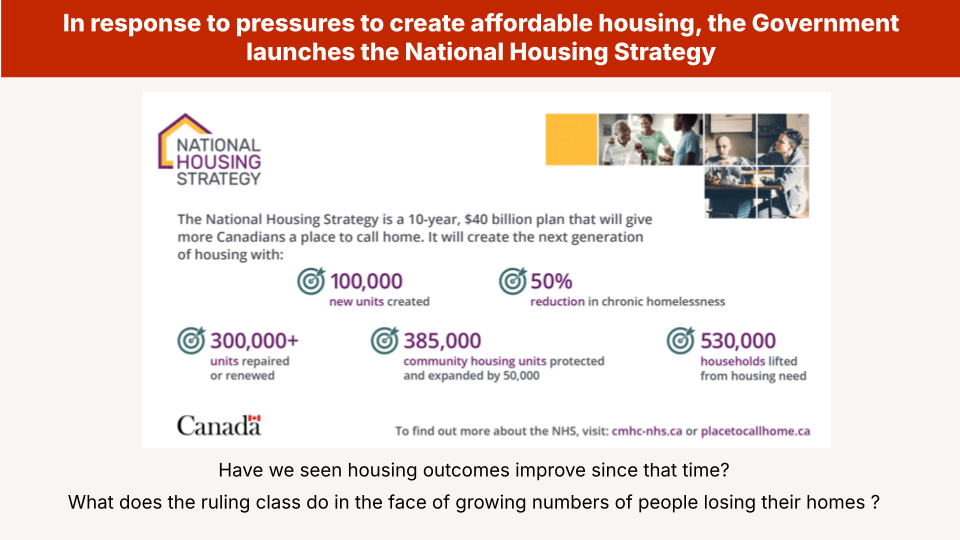
The focus of this Housing strategy was to address “lack of housing supply” through giving very low interest loans and free land to developers. But lack of supply is not the problem, and this strategy only increased renovictions and our rents. Governments chose to finance developers to build unaffordable rentals instead of building social housing and co-ops. Affordable housing scarcity has only gotten worse every year since.
So, what are politicians to do in the face of growing numbers of people losing their homes? We definitely heard many announcements about tenant protection from all three levels of government! A telling one is when they say they will give more money to Tenant support Organizations! Why should we even need those if we were truly protected? Overwhelmingly, announcements from the government focus on easing the way for developers to build ever taller buildings and destroying affordable ones in the process.
At the city level, Vancouver has also been promoting development of new rentals through subsidies to corporations with the result we witness today. The city also chose to ask staff to study the possible impact of returning to a Vacancy Control policy which was dismissed as unrealistic.
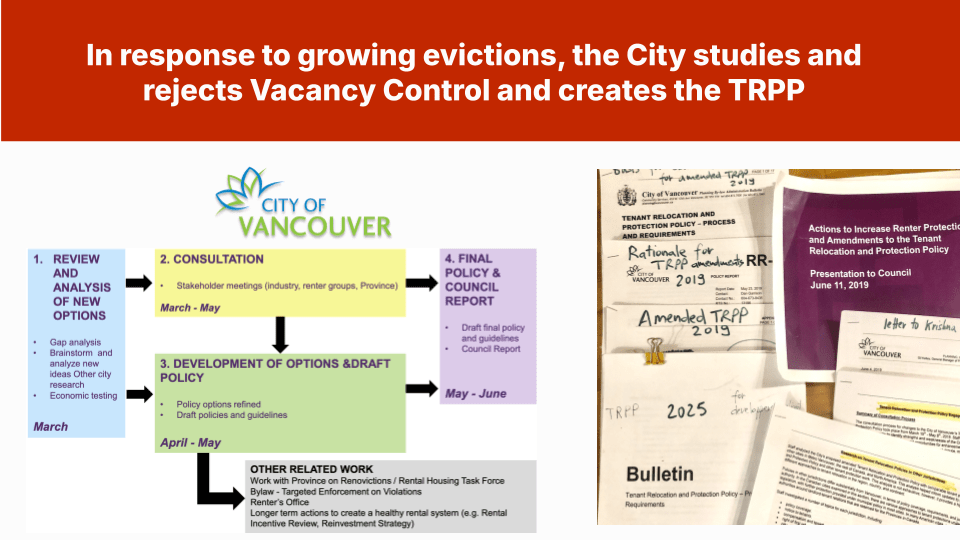
Summarizing the TRPP is impossible, not least because it contains so many contradictions. In fact, both tenants and developers are warned by the City to seek the help of advocates and lawyers respectively to interpret it. We shall look instead at three of the main promises made to tenants:
- Financial Compensation
- Relocation assistance
- Right of First Refusal
First, FINANCIAL COMPENSATION:
The one month free rent compensation imposed by the RTA for any evictions has been increased in the TRPP for tenants in buildings of 4 units or more. It is now imposed at 4 months minimum free rent (and increasing amounts depending on the length of the tenancy all the way to 24 months free rent for a 40 year tenancy). This “improvement” is meant to look very good indeed! But with average length of tenancy around 6 years, a majority of 2 year tenancies, and asking rents being around $2,000 for one bedroom in Marpole, any amount of money received will not cover the new rents for very long.
Second, RELOCATION ASSISTANCE:
Requirements to assist with relocation have been slowly downgraded since the inception of the TRPP. Initially, if your building underwent renovation, you were supposed to be relocated to a building of your choice in your neighbourhood at average city rents, and for “vulnerable tenants”, the rent had to be within 10% of the old rent.
Now, the “average rent” requirement has been replaced by “rent within the tenant budget and other preferences”. It was vague language to begin with and still vague now: “what’s an average rent”, which area are we talking about? What is within a tenant budget ? Who is vulnerable ?
Actually “Vulnerable” is one word the city took great pains to define. So now, in order to get assistance to relocate, one must submit a very invasive Needs Assessment form. Only the vulnerable who pass the test of absolute poverty and disability may be provided a relocation specialist: this is the equivalent of begging for a place to live. Relocation specialists are not magicians, they will not find housing where none exist.
Third, the RIGHT OF FIRST REFUSAL:
The residential Tenancy Act gives a demovicted tenant the choice to return to the new building at the new market rent. The City of Vancouver seeks to improve this by mandating that the new rent should be at a 20% discount on “average starting rent”. “Average starting rent” is again incredibly vague. But, we know it definitely means paying a lot more.
But, let’s be real, in addition to a tremendous financial hardship, an eviction also means the disruption of all our lives! Moving for an unknown number of years, new landlords, new schools, new commutes. New everything and returning to a completely transformed neighbourhood.
The very same hardships apply to people evicted from Transit Oriented Development (TOD) zones. South Vancouver has 4 of them. These zones are covered by the Enhanced TRPP. Depending on what type of building replaces yours, (the Enhanced TRPP only applies to purpose-build rentals and social housing, not if your building is replaced by condominiums). Tenants will have to choose between the one off financial compensation OR choose rent top-ups on the temporary rental until they return to the new building at their old rent. The language about amounts of top-ups and longevity of the rent top-ups (averages are again included in the policy, but how long is an average length of time for constructing a brand new building ? They say 3 years, but it’s easy to predict all kinds of delays including bankruptcies. As monopolies increase, many businesses are indeed failing. The language is so dense and obscure, it’s no wonder tenants need expert support.
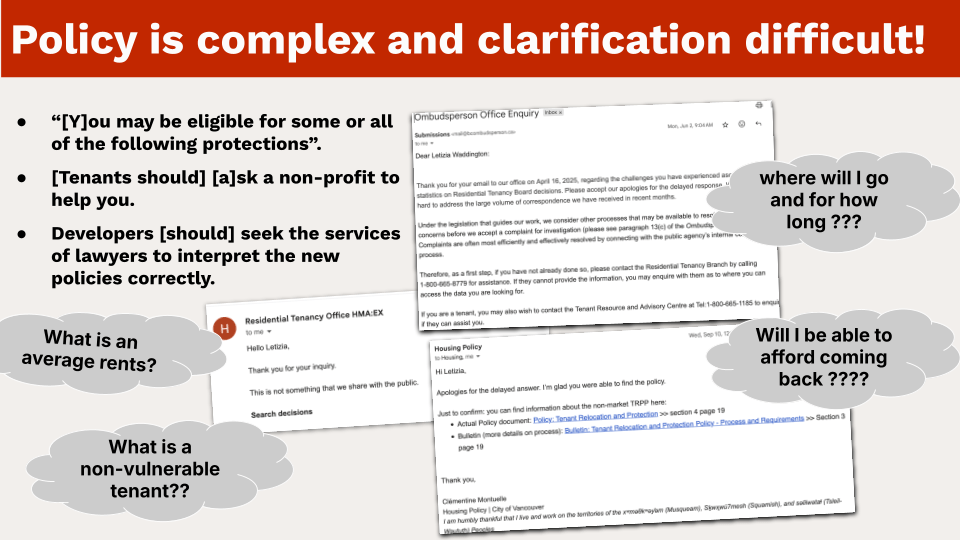
To sum all this up, tenant protection policies are extremely difficult to understand and seeking clarification has proven impossible. Many emails were sent to City planners and City housing staff to clarify “average rents,” and “length of the rent top-ups”. We get a few polite words back and links to the policy. We also heard that the TRPP is being amended once more for 2026.
Clearly, these policies are in place to pacify us, and not serve us. Tenant Protections do not protect renters, they protect profits.The only true relocation we can think of is the relocation of working class money into the pockets of the wealthy.
It is pacification, because it is used to prevent us from resisting evictions and entices us to settle for crumbs.
We call it the Tenant Pacification as it does not really protect us – it pays us off to “relocate” us out of our neighbourhoods to … no one knows where exactly and at much higher rents.

 United in Struggle
Leave a comment