
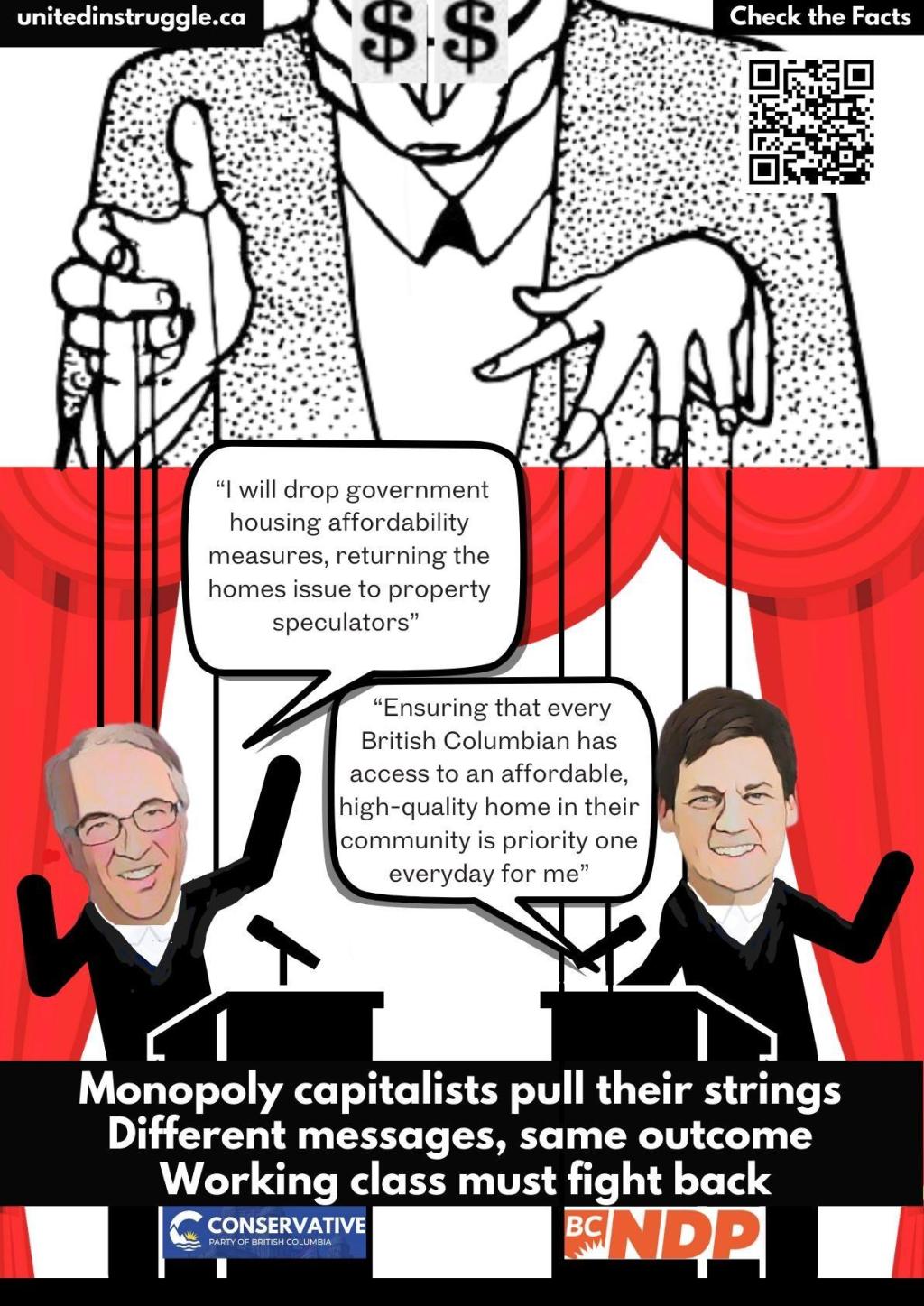
The worsening housing crisis across Canada has been met with performative displays of concern from politicians, complex and contradictory government initiatives, and huge pledges of our tax dollars and public lands. Despite the hundreds of new policies, programs, and funding mechanisms, the housing crisis has only continued to worsen.
In reality, the government’s policies are working exactly as designed. Their goal was never to make housing affordable for working people. The aims of the state’s actions are to:
1. Pacify the People. By bombarding us with a myriad of confusing announcements, the government builds the narrative that they are working hard to address the housing crisis. This strategy aims to quell the people’s dissatisfaction towards the status quo and encourages us not to demand real change.
2. Protect Developer and Monopoly Capitalist Interests. The policies being presented as solutions only increase profits for the perpetrators behind the housing crisis.
3. Financialize Housing and Pave the Way for a Housing Monopoly. The state’s commitment to deregulating the housing market, subsidizing big corporations, and supporting Real Estate Investment Trusts (REITs) pave the way for a fully consolidated housing monopoly.
Over a third of renters in BC are spending more than they can afford on rent. With rent increasing faster than wages, more and more working people are facing eviction with nowhere else to go. The state is upholding the housing crisis and working in the interests of our enemies. The only way this will change is if we fight for change.
SECTION 1: GOVERNMENT POLICIES ARE A FAÇADE DESIGNED TO FALSELY PACIFY THE PEOPLE
Government policies mystify the real cause of the housing crisis, divide working people, and suppress our growing resentment by handing us crumbs.
The government works hard to suggest that the cause of the housing crisis is anything but capitalist greed. Meaningless policies such as taxes on empty homes, foreign buyers, flipping properties, or limits on short term rentals mystify the real cause of the housing crisis. The problem isn’t that there are too many AirBnBs in Vancouver or too many homes sitting empty. The problem is that our homes are owned by a wealthy few, who rent them to us at exorbitant prices to extract as much profit as possible.
As the government tries to direct our attention towards these illogical false solutions, they also work hard to blame international students and foreign workers for driving up the demand for housing. Numbers clearly illustrate that this isn’t true, and that the housing crisis is not a result of increasing demand. For example, Richmond has built 50% more housing units than the population has grown but housing prices have still risen 60%. Limiting the number of international students and foreign workers to Canada won’t solve the housing crisis but it will create worsening conditions for vulnerable workers.
Rent to own policies again imply that the housing crisis is a result of unmet demand and could be resolved if more renters entered the housing market. Instead of enforcing affordable rent, these policies help the richest renters enter into huge debt agreements with the banks. Raising the cap on mortgage insurance to $1.5M, increasing mortgage amortization period to 30 years, and implementing the First Home Savings Plan which allows first time home buyers to use $40,000 tax free savings (saved up in intervals of $8,000 per year) mean that our taxes are being used to help a handful of wealthy renters and pad the pockets of the banks, while secure housing remains out of reach for the majority. Even the idea that we can save $8,000 a year is out of touch when we are living pay-cheque to pay-cheque.
Finally, perhaps the most touted solution is the construction of ‘below market’ rental units. Through the BC Builds program, the provincial and federal governments have committed more than $2B in low interest loans to developers. New builds are encouraged to offer 20% of their units at 20% below market rate until the loan is repaid. This project leaves us with a handful of slightly discounted, yet still unaffordable, rental units that will only be discounted for a few years. The point of these ‘below market’ units isn’t to address the housing crisis and their ineffectiveness is intentional. Their purpose is to act as an example for the government to point to when asked what they are doing, and maintain their pretense of working in our interests.
SECTION 2: THE GOVERNMENT SOLUTION TO THE HOUSING CRISIS IS CORPORATE PROFITS
The federal, provincial, and municipal governments want us to believe that the housing crisis can be solved by building more homes. The National Housing Strategy commits more than $62B through the Apartment Construction Loan Program, the Affordable Housing Fund, the Housing Accelerator Fund, and the Rapid Housing Initiative to subsidize the construction, repair, and renewal of rental units.
Programs that subsidize development only work to protect the financial interests of developers, monopoly capitalists, and the state itself. Rather than providing us with affordable homes, these initiatives see us effectively pay developers twice, first with our tax dollars and then with our rent. Meanwhile, the government collects interest on its loans and makes its own profit. The rich make larger and larger profits, and we are left struggling to make ends meet.
Even though rents have only continued to rise with the increase in construction, B.C. has doubled down with increased deregulation and development funding through the new Housing Supply Act and BC Builds Legislation. The BC Builds Legislation removes regulations around zoning, allowing multiple homes to be built on single family lots and mandating multi-storey towers near to transit centers. It claims to streamline construction by removing goods and services taxes, community amenity contributions, requirements for public hearings, and parking requirements for purpose-built rentals. It also offers density bonuses for rentals, infrastructure grants for municipalities who agree not to raise development levies, and low interest loans for developers building rental units. Nowhere is it required that the built rental units be affordable. In fact, the program explicitly targets high earners and aims to create housing for household incomes ranging from $84,780 – $191,910.
An often-heard argument is that the act of building rental units, regardless of their price, will help resolve the housing crisis as the increase in supply will force costs lower. This is incorrect both empirically and theoretically. Big developers, corporate landlords, and REITs’ business models rely on charging exorbitant rents. Because housing is a basic necessity, they know that we’ll pay their rents until we are on the street. The only way to solve the housing crisis is to undermine these predatory business models and the systems that commodify our homes.
The other act the government often points to as evidence of their supposed work to protect renters’ interests is tenant protections. In 2025, the federal government announced funding for legal aid and renter protection agencies, new mandated disclosures for unit’s historic rent, the creation of a credit score for renters, prohibiting landlords of more than 6 rental suites from evicting tenants from units for their own use, and increasing the obligatory length of time a landlord must occupy the evicted suite to 1 year. But the government won’t consider truly impactful reforms such as prohibiting evictions, limiting rent increases between tenants, or tying rent to income. The meager protections they do allow aren’t even enforced. The tenant board works to serve the landlord’s interests, not ours and more often than not, landlords abuse the law without repercussion.
In addition to protecting corporate profits through subsidizing development and intentionally eroding tenant protections, the government also increases corporations’ profit potential by refusing to build social housing, increasing the number of housing units accessible to private landlords.
In the 90’s, BC decided to stop using the Federal Housing Transfer Payments to build social housing and instead put the funds towards subsidizing landlords. In a similar vein, the federal government effectively stopped building new co-op housing units in 1994. Between 1979 and 1991 they had created an average of 4,000 units every year. If this rate had continued, we would have an additional 122,000 units of co-op housing today.
Through the systematic deregulation of the housing market, dismantling of the already weak tenant protections, and expansion of developer subsidies, the state has prioritized corporate profits above our own housing security. They have consistently demonstrated over the last 30 years that they have no intention of addressing the housing crisis, only using it as a slogan to allow more tax dollars to flow into the hands of the perpetrators: the developers, landlords, and monopoly capitalists.
SECTION 3: THE STATE PLAN FOR HOUSING IS THE HOUSING MONOPOLY
Through the state’s prioritization of corporate and monopoly profits, we can see how they have paved the way for finance capital and the complete commodification of housing. Their commitment to the use of housing as a for-profit industry has resulted in the real-estate industry being the largest contributor to BC’s GDP. The fact that BC’s largest industry explicitly relies on increasing its residents’ cost of living to be profitable is a real problem.
Housing is increasingly viewed as detached from its function as shelter. It is a victim of speculation, bought and sold as a commodity on the global market to garner wealth for obscenely rich shareholders. One of the most successful and predatory vehicles for the extraction of wealth from housing are REITs. These entities own vast property portfolios and allow individuals to own shares of the whole trust. Their business model relies on buying properties in working class neighborhoods, evicting tenants through any means necessary, and raising the rent to extract a profit. They systematically destroy affordable housing, and cities are left with nowhere for working people to live.
Canada Infrastructure Bank, a federal institute, offered the fastest growing REIT in Western Canada, Avenue Living, low interest loans to renovate units in Alberta. There were no conditions attached to this funding and tenants saw rent increases between $500 and $800 a month. Rather than tax, regulate, or prohibit entities like REITs, the state supports their advancement, protects their profits, and sacrifices our wellbeing to do so.
By subsidizing developers and fostering REITs, the government is facilitating the concentration of capital in the hands of the few and accelerating the consolidation of a housing monopoly.
Conclusion
The solutions to the housing crisis put forward by the municipal, provincial, and federal governments do nothing to address the unaffordability of rent for working people. Rather, they increase profits for the developers, corporate landlords, and monopoly capitalists who cause and benefit from the housing crisis. The state’s commitment to commodifying housing has resulted in the complete financialization of our homes and set us on the path to a full housing monopoly.
 United in Struggle