
What do we mean by the housing crisis?
By the housing crisis, we mean the fact that the majority of the working class can’t afford sufficient, safe, and stable housing.
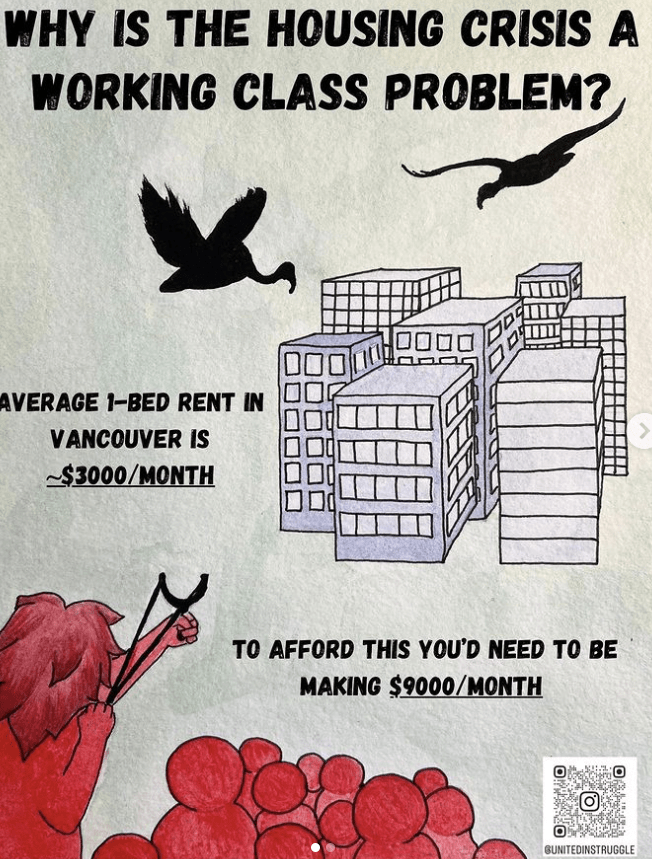
In Vancouver, the average rent for a one-bedroom apartment has almost doubled since 2019 and increased 16% between 2022 and 2023 alone. The average rent for a one bed-room apartment is over $3000 a month and the average rent for a two-bedroom apartment stands at $3,918 a month. To be able to afford these rents, households need to be making $108,000 (after tax) for a one bedroom, and $141,048 (after tax) for a two-bedroom apartment. But the average salary in Vancouver is between $60,000 and $70,000, and minimum wage workers can expect to only make $35,000 annually. The gap between our wages and the cost of housing is only getting larger. When workers do see their wages increase, it is rarely above 4% a year.
What are the root causes of the housing crisis?
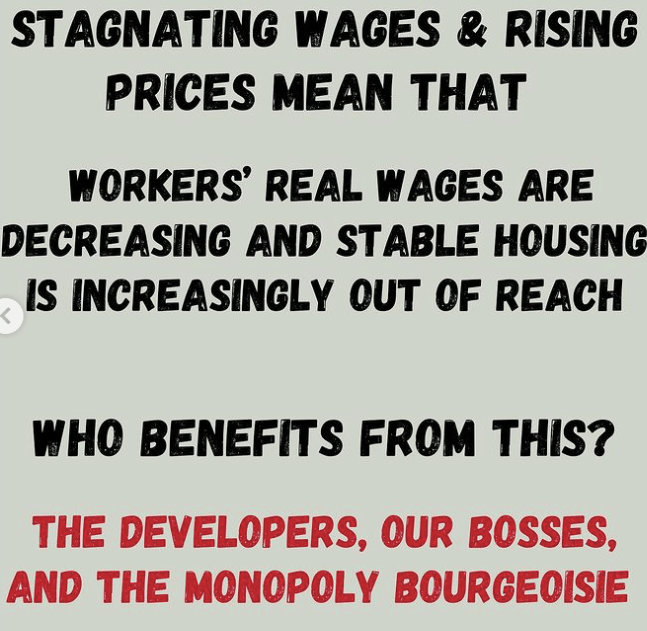
The root cause of the housing crisis is the fact that stagnating wages and rising prices mean that workers’ real wages are decreasing, making housing increasingly difficult to afford. This issue is further exacerbated by the replacement of affordable housing with luxury units which serve as investment opportunities for the world’s wealthiest. The housing crisis is not a question of supply and demand, but a consequence of a system that ignores the material needs of the people to maximise individual profits.
Why are wages stagnating and prices rising?
We are seeing wages stagnate and prices rise because capitalists, like sharks who drown if they stop moving, are driven to constantly grow their wealth. False narratives around inflation, immigration, or the cost of raw materials fail to see that the ruling elites are making record profits year after year.
To understand why capitalists can continue making record profits while the working class has less and less money to spend, it’s helpful to understand how capitalists make money:
- Under capitalism, workers sell their labour power to their bosses in exchange for wages.
- Their boss profits from their labour by exploiting the workers, paying them less than the value their labour creates, and extracting the surplus for themselves.
- In order to continue to increase their profits, the bosses have to maximise this extraction of surplus value and pay their workers less and less.
- Rather than cause an uproar by cutting wages, the capitalist class instead disguises the drop in wages by holding the wage constant and driving up the price of goods.
- The real value of workers’ wages plummets while profits for the bosses soar.
The housing crisis is not a special problem unique to the housing sector. It is replicated across every other industry (food, gas, etc.). It is a symptom of capitalism, and in order to be resolved, the conflicting interests between the workers and the ruling elites must be resolved.
Why is affordable housing being replaced with luxury units no-one asked for?
Increasingly, housing is viewed by the ruling elites as an investment opportunity, devoid from its function as shelter. Since the 1950’s, the real estate market has become increasingly deregulated, financialized, and dominated by networks that are global in scope. Which means that capitalists can profit from housing in ways that were not previously possible.
Decreasing mortgage regulations, diminishing rent protections, and the privatisation of publicly owned or controlled housing has allowed housing to be a more liquid asset. It can change hands easily and profits can be made quickly. Because the housing market has become increasingly financialized, profits can be made not only by buying and selling, but also by owning and speculating. And the globalization of the housing market means that local housing markets are responsive to global economic signals, not local ones, as housing is directly connected to global investment circuits.
A building full of luxury apartments that can demand high rents is a more profitable investment than an old building full of affordable, standard apartments. Therefore, working class apartments are replaced with renovated, high-end units, regardless of local demand, to bolster real estate portfolios and ensure capital growth year after year.
Real Estate Investment Trusts (REIT’s) have emerged under these conditions as key players on the path to a complete housing monopoly. REIT’s own vast portfolios of property and create value for their investors by maximising the revenue each building generates. Their strategy relies on purchasing property in working class neighbourhoods where rent is low, carrying out a mass displacement campaign to remove current tenants, then hiking the rent without limitation before new tenants move in. This strategy is hugely successful and REIT’s are a preferred investment option for many individuals, institutions, and pension funds.
Why is the housing crisis specifically a working-class problem?
The housing crisis is a working-class problem, not because only the working class notice or struggle with exorbitant rents and house prices, but because the root of the housing crisis is the fact that the ruling elites make profits by raising prices and suppressing wages.
This is clear when you consider either of two scenarios. In the first, wages aren’t suppressed but rents are high. There is no crisis here, as though the dollar amount attached to rent may be high, it is an affordable percentage of an average income. In the second scenario, both wages and rent are low. There is no crisis here, as though the dollar amount representing someone’s salary is small, their shelter consumes an affordable percentage of it. Today’s housing crisis is a direct result of the ruling elites’ intentional and systematic depression of wages and surge in prices, all to maximise their individual profits.
Another clarifying scenario that reveals the class character of the housing crisis is to imagine if rent were abolished and housing nationalised. In this case, the working class would suddenly have more money available to spend on other necessities like groceries, clothes, and electricity. Following housing nationalisation, these sectors would soon see massive inflation, as the capitalists are now able to demand much higher prices, knowing that the masses have more money at their disposal and will give everything to have their needs met. The suffering of the working class, the disparity between their wages and the cost of their essential needs, would remain constant. To overcome this, it is essential that workers control all key industrial sectors, including housing.
The ruling elites conspire both implicitly and explicitly, between themselves and with the state, to ensure as much wealth as possible ends up in their hands. In 2023, Vancouver city council voted to return $3.8M to developers that was collected as a part of the Empty Homes Tax, introduced to solve the supply issue that was supposedly driving the housing crisis. The BC and Vancouver Governments increasingly pass policies that lower building costs and regulations which only work to line the pockets of developers and construction companies. And the newest distraction tactic – blaming the housing crisis on international students – only serves to divide the working class. The ruling class intentionally works together to ensure the few continue to thrive, at the expense of the masses.
A capitalist’s profit is maximised when they can minimize how much they pay their workers and maximise how much they charge for their product. Though the capitalist who pays poor wages and the one who demands obscene rents may be different individuals, they are on the same team. These different capitalists comprise the ruling class, the bourgeoisie, who abuse the working class, the proletariat, to hoard evermore wealth. This is why the housing crisis is a class issue.
What is the solution to the housing crisis?
To solve the housing crisis, we need to resolve the contradiction between the bourgeoisie and the proletariat. Individuals can no longer hoard the wealth that we collectively create and leave us with barely enough to survive. In order for the masses to reliably have their needs met, our society can no longer rely on the exploitation of the proletariat to build wealth for the bourgeoisie.
To change our society, we need to unite, build a revolutionary vision, and struggle for systems that benefit us – our families and communities – not the ruling elites.
 United in Struggle