

Background and Objectives:
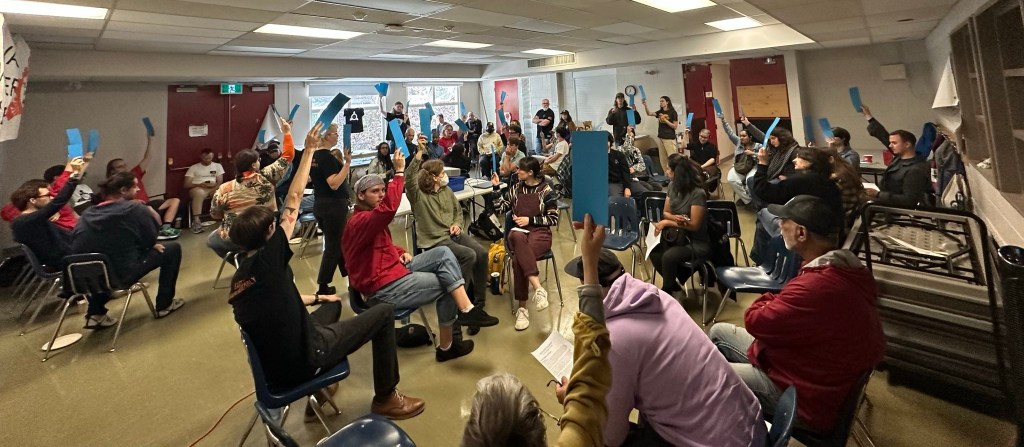
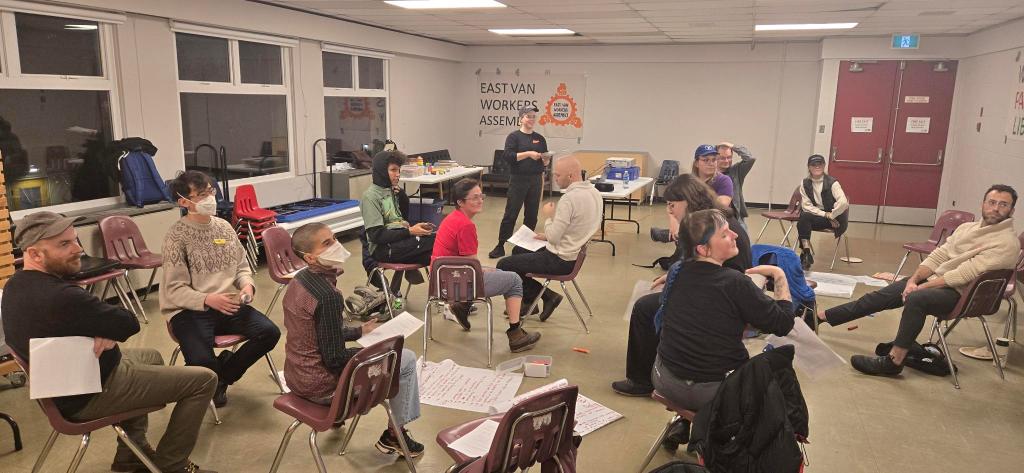
The East Van Workers Assembly (EVWA) is an organisation of workers fighting for the economic and political power of the working class.
The objectives of the EVWA are to:
- Organise and unite workers across industries.
- Develop working class consciousness.
- Struggle to expand and democratise the workers movement.
- Unite the economic struggles of workers in the union movement with a revolutionary political vision.
Founded in July of 2023, the EVWA has spent the last year building the Workers Platform as our political basis of unity and our long-term vision for a combative workers movement, conducting regular investigation at workplaces in Vancouver, mobilising support and solidarity with striking workers, establishing ties with the union movement, developing relationships with organised workers, and building our membership and infrastructure.
The next step forward for the EVWA is a political campaign through which to agitate and mobilise workers against the common class enemies that all unions and workers are up against. This is why we are launching a campaign to build the unity and political consciousness of the working class, and to take up the fight against the monopoly capitalists who control Canadian society.
The broad objectives of this campaign are to:
- (Educate) Raise the class consciousness of members of the East Van Workers Assembly in particular, and workers in general, through presenting a clear political line directed at the monopoly capitalists as our main enemy.
- (Organise) Consolidate members and supporters of the EVWA through leading them to conduct basic political work among workers: investigation, agitation, and mobilisation.
- Broaden the connections of the EVWA to the union movement, and deepen our existing relationships with unions.
- (Mobilise) Expand the active membership of the EVWA, particularly in sectors that are acutely affected, and lay the groundwork for expansion of the political organisation of workers in BC.
- Target monopoly capitalists and push forward class struggle through a mass campaign that pressures the government to secure worker interests.
These political objectives reflect the understanding that campaigns are stepping stones that allow us to approach our longer term strategic interests and goals. In order to achieve these we must launch and fight campaigns to expand and deepen our political work amongst the broad masses of workers, and within the union movement.
Rationale:
In 2023 there were approximately 5 workplace deaths a day in Canada. In BC, there were 181 workplace deaths in 2022, and 175 in 2023, two of the top 3 deadliest years for workers in almost 50 years. On February 21st, 2024, Yuridia Flores, a construction worker for EllisDon and mother of two was killed at a construction site near Cambie and W. 41st.
Gross workplace conditions and lack of accountability by employers and government officials for workplace injury and death have sparked an outrage in the workers movement. On April 28th, 2024, the national day of mourning for workers killed on the job in Canada, the North Star media quoted Rob Ashton, the president of the International Longshore and Warehouse Union (ILWU) in Canada saying: “Employers fight us at every turn to change the rules in this country. We won’t be standing shoulder-to-shoulder with employers on April 28 anymore. [The ILWU] passed a resolution last week never to attend this event again. We’re going to do our own thing because one day out of the year, April 28, we don’t believe belongs to the employers. It belongs to the workers because it is the employers who are killing our people.” Bea Bruske, president of the Canadian Labour Congress (CLC) said in her statement: “When an employer fails workers, they deserve to go to jail. When there’s criminal negligence, the employer deserves to pay that price and go to jail, not just pay a fine.”
Actions which should be taken by the government to defend the safety of workers and hold employers accountable have been ignored. In the 20 years since the adoption of the Westray Law which amended the criminal code to allow employers to be criminally charged for workplace death it has only been successfully applied 11 times, many of these cases coming against small employers. This has led to a relatively static rate in workplace injury and death, which according to some experts could be a serious underestimate as the Workers’ Compensation Board (WCB) only counts those cases in which there is a successful claim for injury or death.
The employers say that they take all the risks of business, but when we’re out talking to workers in their workplaces and communities we constantly hear horror stories of workplace accidents and injuries. We hear stories all the time of workers in extremely difficult and demanding jobs bearing the threat of physical injury from unsafe conditions, and also of psychological injury, often as a result of bullying and harassment from our employers. When bosses lose they’re in the red, when workers lose we end up dead.
In 2022 alone, the WCB accepted 350,000 lost time claims from injuries at work. Among the most common causes is overexertion caused by employers pushing us to work harder and harder. This is only one example of an intentional strategy employed by big business. Weak safety regulations, long working hours, mandatory overtime, and pressuring workers into work they aren’t capable of carrying out, are ways that the bosses place us in conditions which compromise our health and safety. The more we destroy our bodies, destroy our health, the more work they can squeeze out of us, and the more profit they can accumulate. We must expose the tactics used by the capitalists to work us to death for profit.
Demanding that the government hold bosses accountable for workplace injury and death is a class struggle with the potential to unite workers and their organisations around a strong and militant call, with concrete demands, and a clear target against big business owners. Physical and psychological injury, the speed up of workers leading to dangerous conditions, and the threat of bullying and harassment from employers, are struggles that reach across the public and private sectors, across production, distribution, retail, and services.
It is time to take up the struggle against the bosses and hold them accountable for the deadly conditions they place us in every day as workers.
Campaign Call: Bosses Behind Bars: Charge Employers for Workplace Injury and Death
Sub Calls and slogans: When bosses lose they’re in the red, when workers lose we end up dead.
Our Targets:
The struggle against workplace injury and death is a class struggle.
Employers:
It is in the interests of big capitalists and mega corporations to extract as much profit as they can through placing us in difficult and dangerous conditions. Between 2021 and 2022 the most dangerous sectors for workers were: construction, manufacturing, logistics and warehousing, and public services. In Canada, the largest construction companies are PCL Construction, EllisDon, and AtkinsRéalis (formerly SNC-Lavalin). In manufacturing they are: George Weston Limited (which owns Loblaws), Magna International Inc. (which manufactures auto parts), and Nutrien.
While these are just the largest employers in the most dangerous sectors, the struggle against workplace injury and death is an issue that affects all workers no matter their job.
The Provincial and Federal Government:
The failure of the government to protect workers by implementing legislation, or acting on legislation to hold the bosses criminally responsible exposes where the interests of officials lie. Politicians will talk out of the sides of their mouths about the issue and fail to take meaningful action. David Eby said: “The National Day of Mourning is a time to honour workers who have been killed or have suffered injury or illness on the job. It is an opportunity for all of us to recommit to eliminating workplace tragedies”, but has taken no action to hold EllisDon responsible for the death of Yuridia Flores.
We know that politicians will only act if we force them to. We must target and pressure politicians to take action against employers, rightfully placing the blame on bosses for working conditions where we risk injury or death.
Government Agencies:
Government agencies like the Workers Compensation Board (WCB) or WorkSafeBC can act to protect our interests at times: they aren’t the enemy. However, the governments they are accountable to are not neutral, and this impacts the operations of these agencies. WorkSafeBC perpetuates the myth that workplace safety is a balance between the rights of workers and employers.
And when they have a surplus, these agencies return money for worker safety to businesses, with the notable example of the ongoing struggle around the $2billion surplus of WorkSafeBC, which the Canadian Federation of Independent Businesses (CFIB) is arguing should simply be returned to employers.
Our Base of Support:
Affected Industries:
Just in 2022, the Workers Compensation Board (WCB) accepted almost 350 thousand lost time claims from injuries at work. This number does not include claims denied by the board or injuries never reported by workers. More shockingly, from 2012 to 2022 more than 10.5 thousand workers were killed while doing their job or as a result of doing their jobs. Like the number of injuries, the real number of deaths are not expressed above since not all claims were accepted by the WCB, or considered as workplace deaths by the board.
Workers in the various sectors of the economy experience different injuries and death at different rates. Construction workers died more than any other sector between 2021 and 2022. The number of accepted death claims by WCB was 396, with exposure to toxic substances and falls as the main causes. Manufacturing workers had 317 accepted death claims, the main cause being exposure to toxic substances. Agriculture workers had 297, the main cause likewise being exposure to toxic substances. Public administration and warehouse/transportation workers almost had the same number at 182 and 183 respectively. The leading causes were exposure to toxic substances and highway accidents.
Health care and social assistance workers had the highest number of accepted lost time claims by the WCB in 2022 at 128 thousand (~36% of all accepted claims in Canada). The leading causes were exposure to toxic substances, overexertion, and violence. Manufacturing workers had approximately 36 thousand accepted claims, and the leading causes were overexertion and exposure to toxic substances. The third highest number of accepted claims by the WCB were among construction workers, totaling approximately 29 thousand. The leading causes were being struck by an object and overexertion. Workers are exposed to dangerous conditions or being worked until physical and mental exhaustion to fill the pockets of their employers.
The threat of physical injury is greater in sectors that involve physical labour: manufacturing, resource extraction, construction, etc. In the service sector burnout and overexertion are main issues experienced by workers. Across the country, more than a fifth of all workers report a high level of work related stress. This is particularly concentrated amongst workers in healthcare and social assistance at 27.3%. And when workers self medicate through substance use, because our jobs are physically damaging or mentally exhausting, we are the ones blamed, and face the threat of losing our jobs.
Our Base and Allies:
This campaign seeks to unite workers who are outraged that employers face no consequences when we get injured or killed at work. In order to bring workers together around this call it is integral that we:
- Conduct sweeping investigation and outreach to bring together all angry workers who can be won to the struggle.
- Conduct industry level investigation and develop campaign materials that target various sectors of workers.
- Mobilise our base as the East Van Workers Assembly to agitate and organise their co-workers.
- Build our relationships with the labour movement, especially unions.
- Use the broadness of the campaign to connect the struggle to place the blame on bosses for workplace injury and death across various sectors of the economy, and promote the understanding of this as a working class struggle.
Unions have taken up the struggle against workplace injury and death. The struggle against workplace injury and death caused by corporate profiteering is a key struggle in the labour movement. As we develop the campaign to put Bosses Behind Bars, we build our relationship to the union movement, as well as to other independent workers organisations, uniting those who can be won over to our call.
As we move this campaign forward it will become increasingly important to build relationships with unions of industrial workers and construction workers, to reach across the various sectors of the economy and draw in some of the most affected workers.
Our Demands:
- Strengthen and enforce the Westray Law and Grant’s Law.
Westray Law:
“On March 31st, 2004, Bill C-45, known as The Westray Law, came into force. The Act amended the Criminal Code to establish the criminal liability of corporations and executives for workplace deaths and injuries.” However, since its codification, the Westray Law has been used only 26 times, with only 11 successful prosecutions. And even in the instance of successful prosecution, the result has often been fines easily paid by corporations.
We call on the government to strengthen the Westray law to expand the ability of prosecutors to seek jail time for executives of big companies which are found criminally negligent in cases of workplace death.
Grant’s Law:
“It included a requirement to pay before you pump, eliminating the hazard of gas and dash incidents. It also required employers to have better safety protocols for all late-night retail workers – those who work at gas stations, convenience stores etc. Grant’s law required training and orientation for new and young workers, hazard assessment elimination and control. It also required two staff on night shifts or a physical barrier between the clerk and customers.”
Grant’s Law was watered down by Christy Clark and the BC Liberals in 2012 weakening the protections and creating alternatives to the strict restrictions that protected workers working alone at night. We demand the government strengthen Grant’s Law to renew the protections for workers.
2. Mandatory WorkSafeBC inquiry into workplaces with multiple claims, and increased mandatory fines for repeat offenders.
According to WorkSafeBC: “Employers are responsible for immediately conducting an investigation into any incident that involves:
- Serious injury to a worker or a worker’s death
- Injury requiring medical treatment
- Minor injury, or no injury, but had the potential for causing serious injury
- Major structural failure or collapse
- Major release of hazardous substances
- Diving incident, as defined by the Occupational Health and Safety (OHS) Regulation
- Dangerous incident involving explosive materials
- Blasting incident causing personal injury”
WorkSafeBC itself says it “may investigate workplace incidents that resulted in a death or an injury or had the potential to cause serious injury”. The current language is weak and ambiguous, with no discussion of repeat injury or illness. There are issues with no mention of things like psychological injury, and only severe incidents require investigation. We demand inquiries into workplaces with repeated WorkSafeBC claims, and that the inquiries are conducted by WorkSafeBC. We demand increased mandatory fines for large businesses who have repeat violations.
3. Employer Criminal Records.
Workers should know who their employer is. We demand a public documentation system through WorkSafeBC so that we can track employers who are repeated offenders, and make informed decisions about who they want to work for.
4. Clear documentation and reporting of workplace deaths across BC including deaths due to chronic conditions caused by work.
While workplace deaths are tracked by the WCB, the number only includes claimants who were accepted. Researchers say that the number of actual workplace deaths could be as much as ten times the reported number. We demand transparent reporting of workplace deaths, including a count of workers who die due to chronic conditions caused by our working conditions.
Take Action:
This campaign will only be successful if the members and supporters of the East Van Workers Assembly take up the call and take action.
- Put up Bosses Behind Bars campaign posters
- Distribute campaign materials in your workplace
- Invite the EVWA to help host a shop level discussion on the campaign issues
- Bring the campaign to your union local and get them to sign on
- Take the EVWA survey on workplace injury
- Sign up as a campaign volunteer
- Join the Solidarity Workers Action Team (SWAT) for regular workplace investigation and outreach
- Join a campaign protest, or help us prepare to mobilise for the National Day of Mourning on April 28th
- Join the EVWA



 United in Struggle
Leave a reply to Bosses Behind Bars: Warehousing and Transportation – United in Struggle Cancel reply