
Employers say they take all the risks of business, but when EVWA organizers talk to workers, we consistently hear stories of workplace strain, accidents, and injuries. Many workers are in difficult and demanding jobs where they face the threat of physical injury from unsafe conditions, and mental strain and psychological injury, too often as a result of bullying and harassment from their bosses. Physical and psychological injury, the speed-up of workers leading to dangerous conditions, and the threat of bullying and harassment from employers reach across the public and private sectors, across production, distribution, retail, and services.
Things won’t get better unless we take up the fight. We are demanding that the government hold bosses accountable for injuries, deaths and deplorable working conditions. Our demands unite workers and their unions on a strong and militant call, with concrete demands and a clear target against big business owners.
Our safety is a class struggle! Let’s hold bosses accountable for the deadly conditions they place us in.
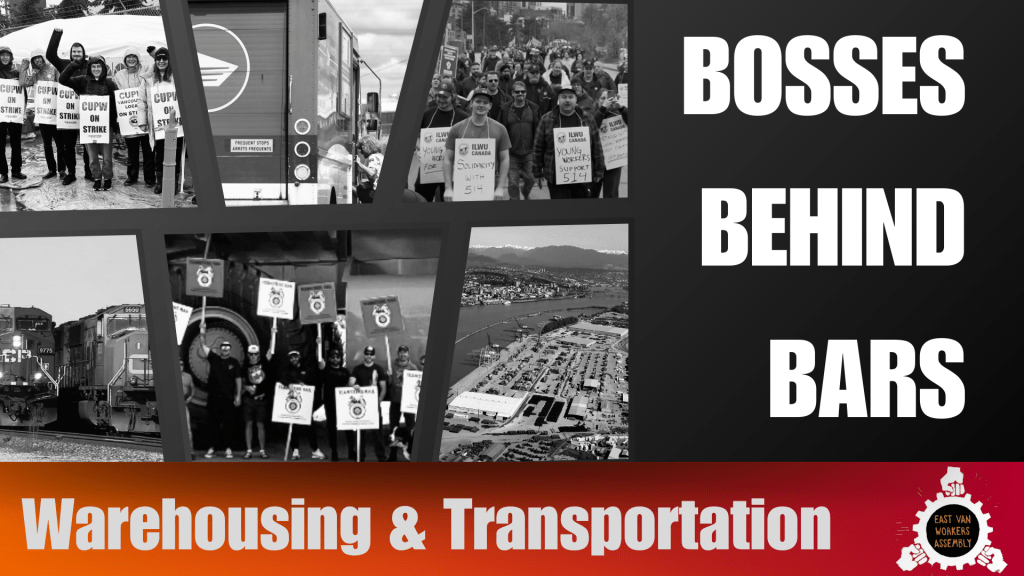
What is the transportation and warehouse sector, and who are its workers?
In British Columbia, over 140,000 workers are employed within the warehouse and transportation sector, including truck drivers, longshoremen, order pickers, and many others.
These workers are necessary for transporting and storing all commodities coming and going throughout the country; they are required for the functioning of the economy. Yet the importance of their work is rarely reflected in their wages and working conditions.
In the warehouse subsector major corporations such as Amazon and Walmart have notoriously terrible working conditions. These corporations hire large numbers of young and immigrant workers, with nearly 30% of warehouse workers being 25 or younger; this is done because employers know it is easier to exploit young and migrant workers. As warehouse workers, we are overworked and underpaid; for reference Amazon pays a starting wage of only $19 an hour and the average warehouse wage is between $21-26 an hour, while at the same time producing billions for the monopoly capitalists. Warehouse workers are seen as a disposable resource to make a profit for their bosses; they don’t care about our health and safety; they force us to work faster than we safely can, which can lead to long-term injuries; they provide inadequate training, which endangers workers and eventually our employers get rid of us when we no longer can be exploited for enough money.
The conditions we work in continue to worsen due to union busting and lack of any significant union presence in warehouses, with the unionization rate in warehouses being shockingly low at only 12%.
When we see how major corporations like Amazon dedicate their time to stopping workers from gaining any collective power, it is no surprise that warehouse workers are underpaid and forced to work in unsafe conditions with no way to protect themselves.
In the transportation sector, which includes jobs such as dock workers, truck drivers, postal workers, etc, the situation is slightly different. With an almost 30% union rate, transportation workers have been able to struggle for better pay and conditions. But like all working-class people, they are still subject to unfair working conditions and exploitation. Transportation workers are often forced to work incredibly long days with unpredictable schedules. They face fatigue and dangerous conditions from overworking, but employers rarely care and consistently try to squeeze more labor from the workers without concern for safety and well-being. We can see even though the transportation sector has a strong and combative union presence, they still become victims of anti-worker legislation. When both the Teamsters and ILWU went on strike, they were given back to work orders and their strikes were made illegal. When transportation workers attempt to better their conditions by using their right to strike, they are forced back to work, with there demands being ignored and there conditions staying the same.
By looking at the transportation and warehouse sector, it’s clear our bosses only care about extracting as much profit from our labor as possible. As workers in this sector our purpose is to continue the flow of commodities and money throughout the market, our needs as workers for safe working conditions and living wages will always be secondary to ensuring large profits for the big monopoly capitalists.
Worker Death and Injury in the Sector
When things go wrong in transportation, it can have catastrophic effects. The most famous example in recent Canadian history is the Lac-Megantic rail disaster in 2013, where a runaway train hauling 72 tankers filled with crude oil derailed as it approached the center of the town of Lac-Mégantic, in Quebec. The tanker cars exploded and the oil caught fire, killing 47 people and destroying many buildings and other infrastructure in the center of town. In the ensuing trial, it came out that it was standard practice at the company to not properly secure their trains.
While this is the most dramatic example, it is emblematic of issues across the entire warehousing and transportation sector. While accidents in warehouses rarely have the newsworthy effects of something like the Lac-Megantic derailment, they are still common and often lethal here in BC. Looking at the statistics released by WorkSafe BC, we see that workers in warehousing and transportation are more likely to be injured and are more likely to have what WorkSafe classifies as a “serious injury” than the average worker in BC.
Furthermore, in the last 20 years there have been 475 deaths in the warehousing and transportation sector across BC – meaning that more than 20 people are dying in our province every year in this sector. This makes warehousing and transportation the third deadliest sector of the economy in BC, after construction and manufacturing. However, unlike construction and manufacturing, the overwhelming majority of the deaths were from workplace incidents rather than work-related disease; in terms of death in the workplace transportation and warehousing is the deadliest sector in BC.
What are Unions and Workers Saying?
Investigating the causes of these high rates of injury and death, multiple unions in the sector – most notably the Teamsters and Unifor – point to overwork and poor training as the leading causes for unsafe work conditions.
Overwork looks a bit different across industries. In transportation (trains, trucks, etc) overwork looks like extremely long hours with very short gaps between shifts. It’s not uncommon to hear workers on the railroads saying that the trains are basically the only thing they have time for in their life. For workers in these conditions, it shouldn’t be surprising that overwork leads to frayed attention spans and extreme fatigue, causing all sorts of accidents.
Meanwhile, in warehouses overwork looks like “speed-up” – the corporate practice of constantly trying to get more and more labor out of each worker while maintaining the same shift schedule. This is often done by introducing new technology in surveillance and automation. Pioneered by Amazon, their techniques for surveilling workers’ every movement and timing every task gives management new tools to force workers to increase productivity, often at the expense of the workers’ safety.
For example, a worker in a warehouse might see that the pallet they are assigned to pick off the top shelf is precariously placed. Bringing it down safely will take more care and more time that it would take them to pick something off the floor. But as far as management’s computer system is concerned, taking that time would be flagged as that worker working at reduced productivity, leading to pressure from management on that worker to speed up.
We see these methods of surveillance spreading across the sector. Last month we heard from postal workers about the surveillance their mail carriers are under. Amazon and other logistics companies implement all sorts of systems of surveillance and control. Theoretically, tracking and automation could be used to help make workers’ lives easier! Methods for planning optimal routes through busy streets or crowded warehouses could help workers avoid accidents, systems of conveyors and lifts can help take away the strain of lifting heavy objects, and so on. But unfortunately these tools are being used against workers in the interest of increasing profits for the bosses and owners of these companies – increased profits that these workers will likely never see a share of.
This is why our Workers Platform that we developed over the course of this year hold the position of Worker Control Over Production. These tools could make all of our lives easier if they were in the hands of the workers who actually do these jobs. Instead, they’re in the hands of management, who use it to undermine workers’ own knowledge they have of how they do their jobs – and this leads to fatigue, injury, and death in the workplace.
Whether it’s long hours or work speed-up, the companies in this sector are all trying to get as much labor as possible out of as few workers as possible, while making the workers they do have as precarious and replaceable as possible. They do all of this in order to increase their own profit margins and make more money for their wealthy investors and owners – all at the expense of the very lives of the workers in this sector.
Strengthening the Westray Law
One of the demands of our Bosses Behind Bars campaign is to strengthen the Westray Law, which is the law that allows individuals to be held accountable for workplace injury and death. There have been a few uses of the Westray Law in the transportation and warehousing sector, and they are perfect examples of the weakness of the law as it currently exists and why it needs to be strengthened. One of the most clear cut examples is this one:
“On October 13, 2006, a train struck a maintenance vehicle, killing one worker and injuring three others. Two employees of Québec-Cartier were charged with criminal negligence causing death and three counts of criminal negligence causing bodily harm. The corporation was not charged. On November 29th, 2010, a Quebec Court acquitted both men on all counts, finding that the incident was an error due to a company culture of tolerance of unsafe practices and deficient training rather than a wanton act of criminal negligence.”
So what we have here is two employees of the company being charged with criminal negligence. When it was found that they were not guilty because of a company culture of unsafe practices, the charges were dropped. That’s great. The problem is that there were no further charges leveled against the company that encouraged these unsafe practices or the high-level company executives personally responsible for cultivating that culture in their quest for big profits and bigger bonuses! Even in situations where the company itself gets fined – which was the case in the Lac-Megantic disaster – top executives are often personally insulated. Even if the company goes under, the company executives can just go get a job at another company as CEO or COO or some consultancy gig and go right back to making more money in a month than most of us make in a year.
This is the main demand of the campaign – Bosses Behind Bars! To make sure bosses are held accountable for the injuries and death they cause means strengthening the Westray Law – so that in cases like this it’s not the employees taking the heat for unsafe company practices, it’s the bosses.
Who are the Enemies?
Starting with warehousing, big companies like Amazon are infamous for union busting. We all know that if we are not organized in our workplaces, we and our coworkers will be squeezed to the maximum for profits. And no wonder warehousing workers die the most from accidents inside their workplace; their unionizing rate is one of the lowest, if not the lowest.
In Richmond, not so long ago, over at the Great Little Box, an un-unionized warehouse, a worker was killed when a 500kg pallet fell on top of him. WorkSafeBC’s investigation found that the employer did a shit job at keeping the workplace safe. But the state did a diligent job of pretending to bring justice to the family by fining the employer 300k dollars. Now, let me ask you, what is it called when an employer gets fined 300k dollars for killing a worker? It’s called the cost of production. Fines are not enough; we gotta put them behind bars; otherwise, punishment for killing a worker will be just another bill worth paying.
It is extremely hard to organize as a warehousing worker, but not impossible. Warehousing workers need to stay mobilized through high job rotation, surveillance schemes, and the management-articulated racial conflicts like the New Westminster Amazon created to demobilize the unionizing campaign by unifor.
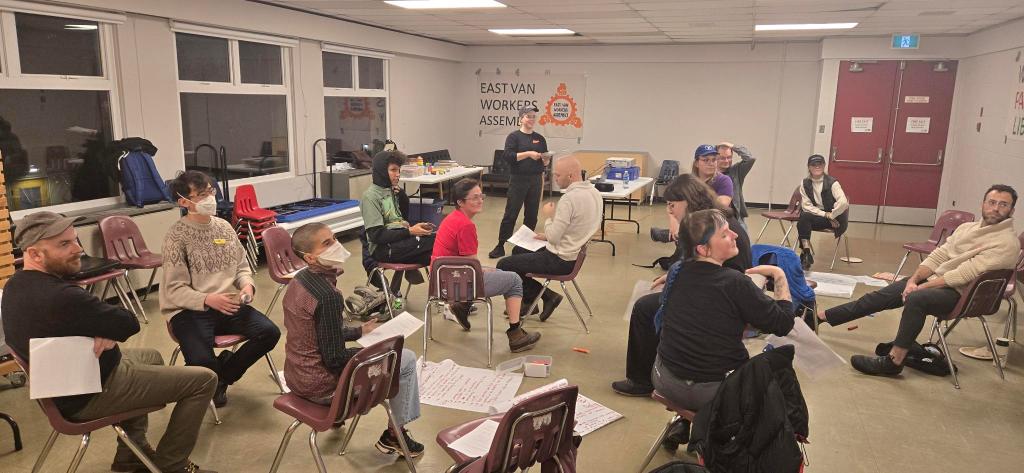
That’s why we need spaces like this assembly, where warehousing workers from different companies can come together, get organized outside their workplaces, and draw strategies for a sector-wide unionization vision. This sector-wide strategy is crucial because even the Amazon workers, or workers at any other big warehouse that was able to get organized, are vulnerable. Because, the threat of the employer moving its operations to a new location and firing everyone is constant
One of our organizers worked in a warehouse where this is exactly what they did. Three days after certification, they sold the building, transferred operations, and fired every single unionized worker. That’s why we can’t have just one organized warehouse; we need an entire region to be organized.
Moving on to transportation, rail workers will tell you about the 12-hour shifts they work, and having to stay away from home longer than anyone should. During the last round of negotiations, the CN and CP duopoly was pushing for longer shifts. And outrageously within 18 hours of the lockout, the labour minister ordered all of the 9,000 workers back to work.
This same tactic was used against ILWU foremen workers after the BC Maritime Employers Association locked them out. The tactic is simple and efficient. Employers refuse to negotiate and wait until the government gives the final blow. But how will rail workers fight for a shift that won’t fatigue them into derailing a train and killing 47 people if they can’t strike? The same question applies to CUPW, who have been frequently ordered back to work throughout it’s history, as well as ILWU workers who just went through that.
During this on-going strike, CUPW workers told us that Canada Post wants to create a new job position to sort the mail for the drivers. This seems inoffensive, but the employer wants to disempower the union by eliminating those two hours drivers spend in the warehouse sorting mail and touching base about workplace issues. On top of that, they would also have to drive for eight hours straight, or more, exposed to snow, icy roads, rain, heatwaves and traffic. And the longer they drive, the longer they are exposed to the elements and city traffic, the higher the rates of injury and deaths will go. And we can be sure that these rates will go up if postal workers get ordered back to work again and can’t continue on the picket line against this bull shit.
So, how do we fight back against union-busting and the collusion between monopoly capitalists and government? Individual locals can’t fight these alone. The laws regulating the labour movement weren’t designed for us to win. So, we need a broad alliance of fighting locals. An alliance not only capable of fighting for our class interests but that will also be able to neutralize the government’s attempt to bodyguard the bosses. One that can be big and strong enough that they won’t be able to fine us into accepting their legal preconditions that dictates how we are allowed to fight.
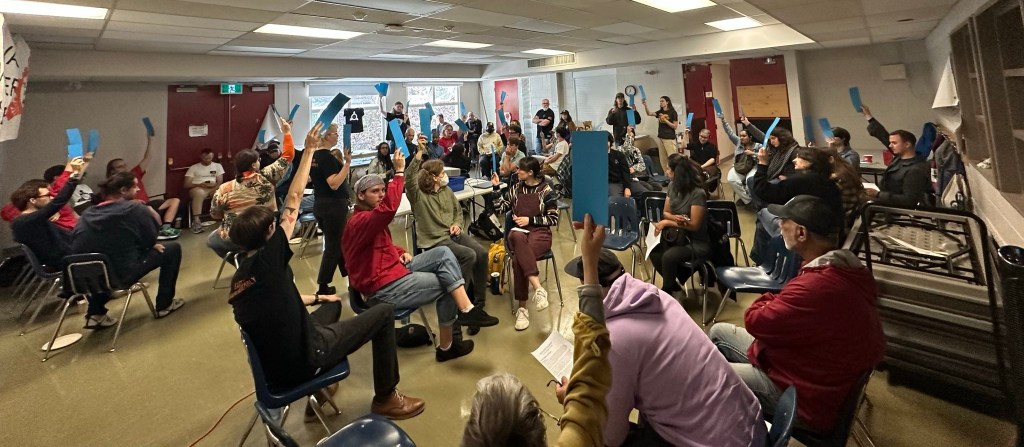
The EVWA and all of us in this room have a role in this. If individual locals can’t do it alone, we, in this assembly, will start uniting the fighting locals to struggle together and strategically. If individual locals get ordered back to work, we, in this assembly, will make sure their fight continues by setting up solidarity picket lines at their workplace’s doorsteps. The fines, the union-busting, and all the other schemes that these rich fucks pull out to chain us onto this system won’t stop us from fighting for what’s ours to conquer. It’s time we bring politics back into the labour movement. It’s time for the working class to rise against the enemy and put them where they should’ve already been: locked up behind bars.


 United in Struggle
Leave a reply to March for Workers Injured and Killed on the Job – United in Struggle Cancel reply